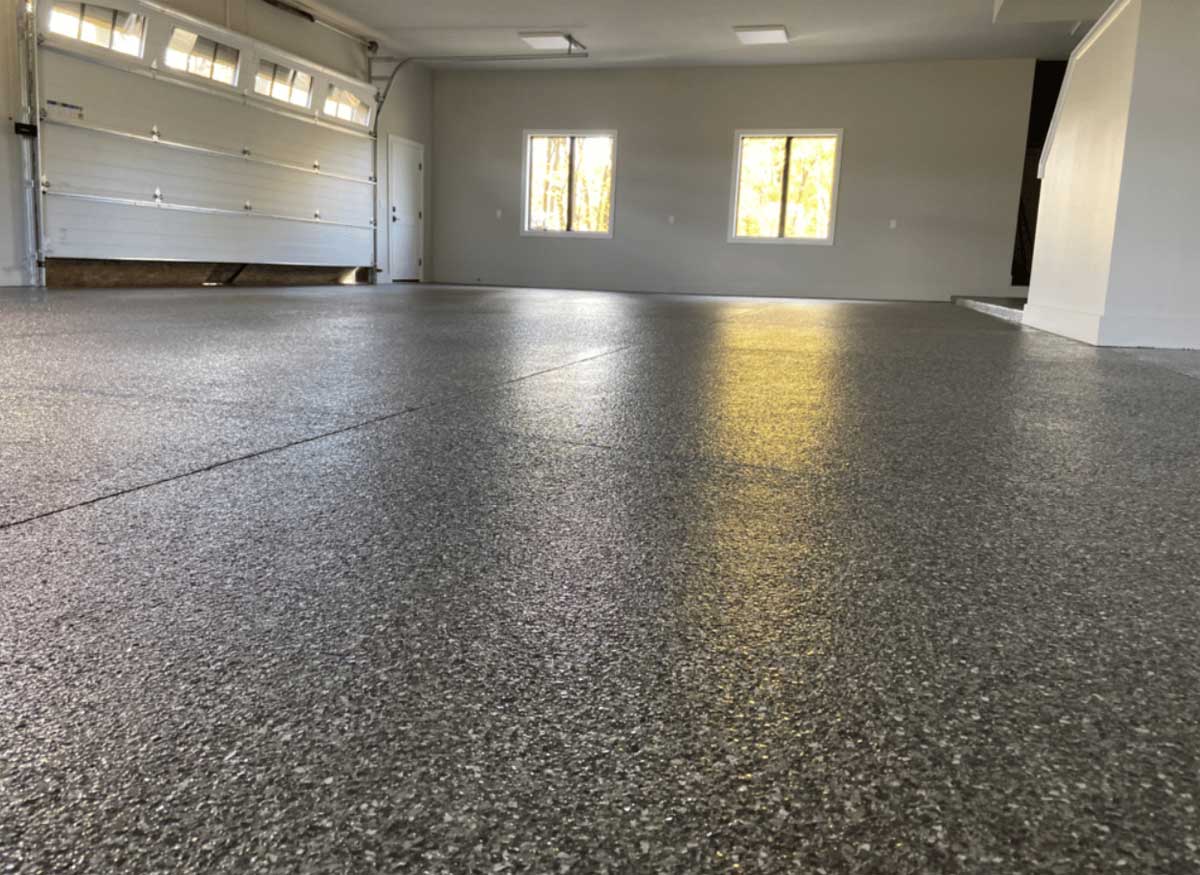
Honestly, has your garage floor seen better days? You’re not alone. It’s no secret that garage floors take a beating: from car tires, to tools, to chemical spills, to other objects falling… Your garage floor gets scratched, chipped, dinged, and stained. Coating it will keep it looking nice and also protect it durably.
5 Untold Benefits of a Polyurea/Polyaspartic Garage Floor Coating
MotorCity has performed hundreds of polyaspartic garage floor coating applications in the Detroit Metro area. We have specialized in several types of concrete floor coatings, including epoxies, polyurea and polyaspartic. We also do concrete refinishing and polishing, especially in industrial applications. Over the years, we have improved the installation process, both at the preparation stage and at the coating installation phase.
With experience, we came to the conclusion that although epoxies were a great material with many excellent proprieties, chemical science has evolved and given us two new materials that perform significantly better than epoxies: polyurea and polyaspertic polymers. We have developed a unique combination of the two materials which draws from their respective strengths to create floor coatings of excellent quality.
Let’s discuss the comparative benefits of the 2 types of materials in the context of a concrete garage floor coating.
1. Enhanced Resilience and Durability
A garage floor coating must be highly resilient and resistant to wear-and-tear: it has to be able to support the pressure that the weight of the car exerts on the contact points with the concrete and the coating; it also has to be able to absord the thermal shock of the temperature of your tires when you just drive in.
When epoxy started to be a material of choice of contractors, in the 1990s, the limitations of epoxy were not yet well measured. Certainly, epoxy manufacturers did not publish studies on how the material would react with tires. Over time, it became obvious that epoxy wasn’t doing very well with heat, pressure, and friction, and industrial testing gradually revealed why car tires were leaving black marks on the epoxy.
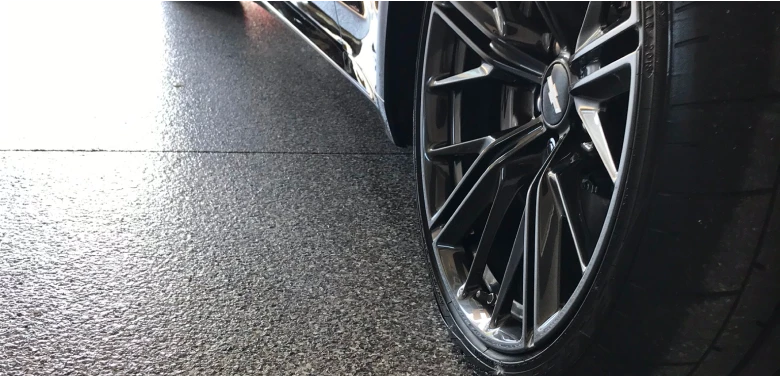
When the epoxy has a low Tg (glass transition temperature), when it has cured incompletely, or when it is affected by a thin film build, weak crosslink density, or poor topcoat chemistry, the tire contact patch slightly softens the coating surface. When the tire cools while sitting on the floor, the rubber and coating develop temporary adhesion. Then, when the vehicle moves, the tire can pull, scuff, or imprint the softened surface. This is the origin of the “hot tire pickup” phenomenon, the black marks that develop over time: the epoxy loses gloss, and shows tire-shaped dulling. It can even peel in weak systems.
2. Long-lasting Stunning Looks
A good floor coating gives your garage a fresh, modern look. Once we apply the polyurea coat, we cast a blend of flakes over it which gives the coat its colorful aspect. We carry multiple flake blends so you can choose something that complements the style of your home.
The preparation process of the concrete is of primary importance: the concrete first needs to be decontaminated if there are heavy oily patches on it. Then we grind to level it, and repair and fill chips and cracks. We then grind it a second time and remove all dust to leave a very clean concrete.
The polyurea base coat will finish evening out small imperfections on the surface. Then the flakes are cast and spread over the base coat. Finally, we apply the polyaspartic polymer as the top coat, which gives the surface a shiny aspect and its hardness.
The two coats will contract and expand with the concrete, contrary to an epoxy coat which hardens without elasticity. This explains why the epoxy coat cracks after a few years: it can’t stretch with the thermal, hygrometric, and topographic variations that affect the concrete substrate.
Lastly, the flake blend is not a uniform color. That palette helps hiding stains and small chips that will unavoidably happen over the life of the installation.
3. Easier Maintenance
The polyurea/polyaspartic garage floor coating makes is easier to keep the floor clean: just vacuum-clean and mop it. The chemical and physical properties of the coating make it water- and stain-resistant: it doesn’t absorb dirt and grime as would a raw concrete slab. There is always a risk in a garage to drop harsh chemicals accidentally on the floor. The polyaspartic top coat prevents absorption. Simply mop it quickly and no residual stain will show.
4. A Safer Surface
The dual-layer garage floor coating system we have developed makes your garage safer to work and walk in. Before we apply the top coat, we mix it with a material which gives a slight degree of abrasion (grit). The surface become slip-resistant, which reduces the risk of slips and falls, especially when it rains or snows outside and your shoes and vehicles create puddles of water.
Because the coating is also resistant to oils and chemicals, any spill can be mopped before it starts emitting long-lasting smells (gases). This coating is also safer for your lungs.
5. A Cost-effective Coating
A polyaspartic garage floor coating last longer than latex and epoxy coatings. You will not need to replace or refinish it for years. We offer an industry-leading warranty, which you can actionate if your floor coating shows small chips due to technical issues.
This combination of durability and warranty makes our dual-layer system an effective and economically efficient option.
In the table below, we compare the properties of epoxy and of the proprietary polyurea/polyaspartic dual-layer system we have developed.
| Stress type | Epoxy floor coating | Polyurea base coat + polyaspartic topcoat | Practical meaning |
|---|---|---|---|
| Abrasion | Often strong, especially with high-solids industrial epoxy, but exposed epoxy can dull or scratch under grit and tire shear | Strong; polyaspartic topcoats usually provide better abrasion resistance and surface hardness than basic epoxy wear layers | The polyaspartic wear layer usually handles garage traffic, foot traffic, and grit better than exposed epoxy |
| Oil / many chemicals | Often strong against motor oil, grease, and many household chemicals | Strong; polyaspartic topcoats resist many automotive fluids and common garage chemicals | Both systems perform well, but final resistance depends on the specific resin chemistry and cure quality |
| Compressive load | Strong when fully cured and properly bonded to concrete | Strong; polyurea base coats bond well to prepared concrete and tolerate slab movement better than brittle epoxy | Both resist vehicle weight, but polyurea systems usually tolerate substrate movement better |
| Impact / dropped tools | Moderate to strong, but more brittle epoxy films can chip or fracture under sharp impact | Strong; polyurea base coats have more elongation and impact tolerance | The polyurea base coat usually gives the system better toughness under impact |
| Flexibility / slab movement | Lower flexibility; rigid epoxy can crack when concrete moves or cracks telegraph through the coating | Higher flexibility; polyurea has higher elongation than epoxy and better accommodates minor concrete movement | Polyurea + polyaspartic systems usually outperform epoxy on moving or imperfect slabs |
| UV exposure | Often weak unless protected; many epoxies amber, chalk, or lose gloss under UV | Better; aliphatic polyaspartic topcoats resist UV yellowing better than epoxy | Polyaspartic topcoat gives better color stability in garages with sunlight exposure |
| Hot tire dwell + plasticizer transfer | Variable; exposed epoxy is more prone to hot tire marking, staining, softening, or pickup | Better resistance; polyaspartic topcoats usually resist hot tire pickup and tire staining better than standard epoxy | The polyaspartic topcoat gives the system a stronger defense against hot tire marks |
| Heat near glass transition temperature | Variable; epoxy can soften near its glass transition temperature, especially in lower-grade or under-cured systems | Generally better surface performance, though all polymers have thermal limits | Polyurea/polyaspartic systems usually resist hot tire stress better, but product formulation still controls final performance |
| Cure speed | Slower; many epoxy systems need longer wait times before vehicle traffic | Faster; polyurea and polyaspartic systems usually cure faster and allow quicker return to service | Polyurea/polyaspartic systems fit one-day garage coating workflows more easily |
| Moisture tolerance during installation | Variable; many epoxies dislike moisture vapor and damp concrete | Variable; some polyurea base coats tolerate concrete moisture better, but installers still need moisture testing | The system only performs well when the installer matches primer/base coat to slab conditions |
| Adhesion to prepared concrete | Strong with proper grinding, cleaning, and cure conditions | Strong; polyurea base coats often penetrate and bond aggressively to prepared concrete | Both systems need mechanical surface preparation; resin choice does not compensate for poor grinding |
| Best role in a garage floor system | Good primer/base or build coat; weaker choice as an exposed topcoat in UV or hot-tire conditions | Better complete garage system when polyurea bonds to concrete and polyaspartic serves as the wear surface | The polyurea + polyaspartic combination usually beats exposed epoxy for residential garage use |
Selecting the Best Floor Coating for Your Application
From all the options available on the market, how do you pick the right coating for your garage floor? Ask yourself these questions:
1. What Type of Traffic Does My Garage Get?
The volume of traffic your garage sees will determine the type of coating to use. If you have a lot of foot traffic, you are probably better off opting for a harder coating like epoxy and polyurea. If your garage is mainly used for storage, a less durable coating like latex or acrylic will be OK. If you have a workbench in your garage and do a lot of DIY, a polyurea coating will be much more durable than a
2. What Is My Budget?
The cost of a coating job on a garage floor can range from a few hundred dollars for a basic coating to thousands for a more elaborate one, depending on the total surface to cover. Knowing your budget beforehand will help you narrow down your options as prices of the primary material vary significantly, and the cost of labor depends on the complexity of the job. In general, we recommend avoiding going for the cheapest option: it’s better to save a few more months and select a coating that will last several years, than to select a coating with a very short shelf life. Also, your contractor has to prep up the surface of your concrete, and if this step is not done right, your garage floor coating will start chipping within a couple of years.
3. What Color Do I Want?
Polyurea/polyaspartic coatings come in a diverse palette of colors. (Click on the link to see the palette we offer). If you want something that stands out or on the bright side, opt for “Safari”, “Sandstone”, or “Orbit”. If you prefer a more subtle tone, go with a neutral color like “Silver Creek”, “Slate”, or “Pebble Beach”. The choice of color depends on your house color palette, but also on practical aspects like “if I drop a screw, how hard will it be to find it?”.
4. Do I Want a Glossy or Matte Finish?
Different coatings provide different finishes, glossy or matte. If you prefer a glossy one, look for oil-based coatings — epoxy or polyurethane. If you want a matte finish, opt for latex or acrylic. A glossy finish makes your floors look shiny and reflective. A matte finish makes the floor look much more muted. Based on our customers’ input, glossy is the preferred choice of most.
5. Do I Need a Waterproofed Garage Floor?
If your garage is prone to flooding or moisture, you’ll need a coating that waterproofs it. Polyurethane and epoxy are the best options for this, as they create a protective barrier against water. In the polyurea/polyaspartic combination, the polyurea is the base coast and it prevents moisture below the concrete from sipping up. The polyaspartic topcoat prevents spills from infiltrating the concrete.
6. How Long Should My Coating Last?
The durability of a garage floor coating depends on the type of coating material you choose, and on the thoroughness of the preparation work. Oil-based coatings like epoxy and polyurethane tend to last longer than latex coatings, which typically lasts around five years. For the longest-lasting protection, a polyurea/polyaspartic combination coating is the best option, with a lifespan of up to 15 years.
Conclusion
As you can see, garage floor coatings preserve the life of your concrete floor and keep your garage beautiful and a place to share. If your garage floor needs a bit of TLC because it is cracked or pitted, no problem: we prepare the concrete surface thoroughly to obtain maximum adherence of the coating to the concrete, for a long-lasting application. The preparation work will be critical to your enjoyment of your new floor for years to come.
We know there are many options out there. Many different types of coatings, many colors, and also many contractors. Call us at (248) 613-5888 to discuss your project and ask us any technical question. Our floor coating specialists are very knowledgeable with years of experience under their belt. If you want to go further, we’ll give you a quote free of charge and without any commitment on your part.
MotorCity Floors and Coatings offer premium concrete coatings for commercial, industrial, and residential use. We specialize in epoxy, polyurea, and polyaspartic coatings, and serve the entire Detroit Metro area. Our headquarters are based in Novi, MI. Check our 4.9 rating and customer reviews on Google to see the love we receive from the people we serve.