 Skip to content
Comparing an Epoxy Floor Coating in Clawson with a Polyaspartic System
QUESTIONS? NEED A QUOTE?
Epoxy or Polyaspartic for a Clawson Garage?
Comparing epoxy floor coating in Clawson to polyurea-polyaspartic comes down to Michigan’s climate: freeze-thaw cycles, road salt, and UV at the apron are exactly the conditions epoxy handles worst. The trade-off is real: epoxy costs less upfront and anyone can buy a DIY kit, while polyaspartic costs more and requires a trained crew. But on a slab that’s still moving, like North Bywood Avenue, or cracked in multiple directions, like Highland Avenue, a flexible, fast-curing system holds up in ways a rigid film does not.
What We Actually Found in Clawson
Three Clawson projects on our case-study page show what a Clawson garage floor is actually up against, and why the material choice matters before anything gets sprayed or rolled.
North Bywood Avenue — A New Pour Still Moving
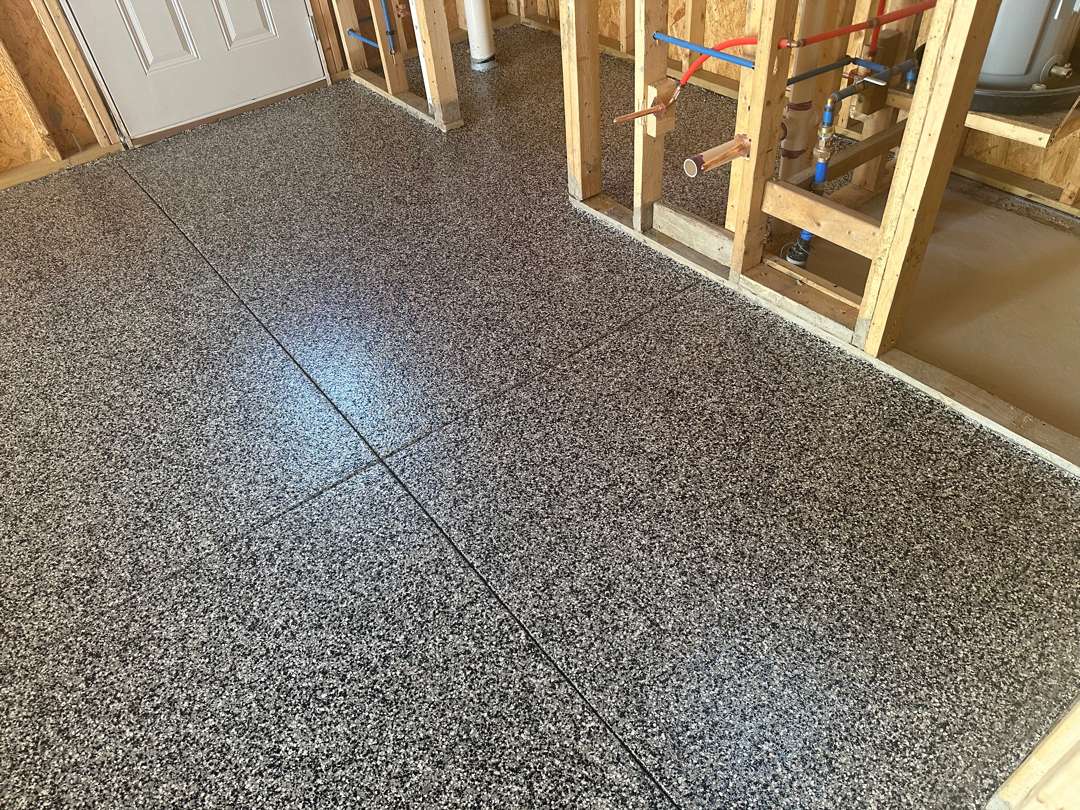
On North Bywood Avenue, we coated a 537-square-foot garage in a house still under construction — open stud framing, construction debris, and fluid pooling near a plumbing rough-in. The concrete was new, poured directly against the block foundation wall with a rough, uneven edge at the perimeter, and a void ran across the threshold where a 2×4 had been pulled from the slab. New concrete like this keeps releasing moisture and keeps moving for months after the pour. That’s the exact condition where a rigid epoxy film is most likely to blister, lose adhesion, or crack along with the slab. We diamond-ground the full 537 square feet to open the surface, mended the perimeter seam and threshold void flush, ran a second grind, then applied our MC-3.8 polyurea-polyaspartic system in Domino, a dark charcoal flake blend, finished with a 16-grit traction topcoat. The homeowner had a garage floor ready to use within a day, not weeks.

Highland Avenue — Cracking a Brittle Coating Would Telegraph
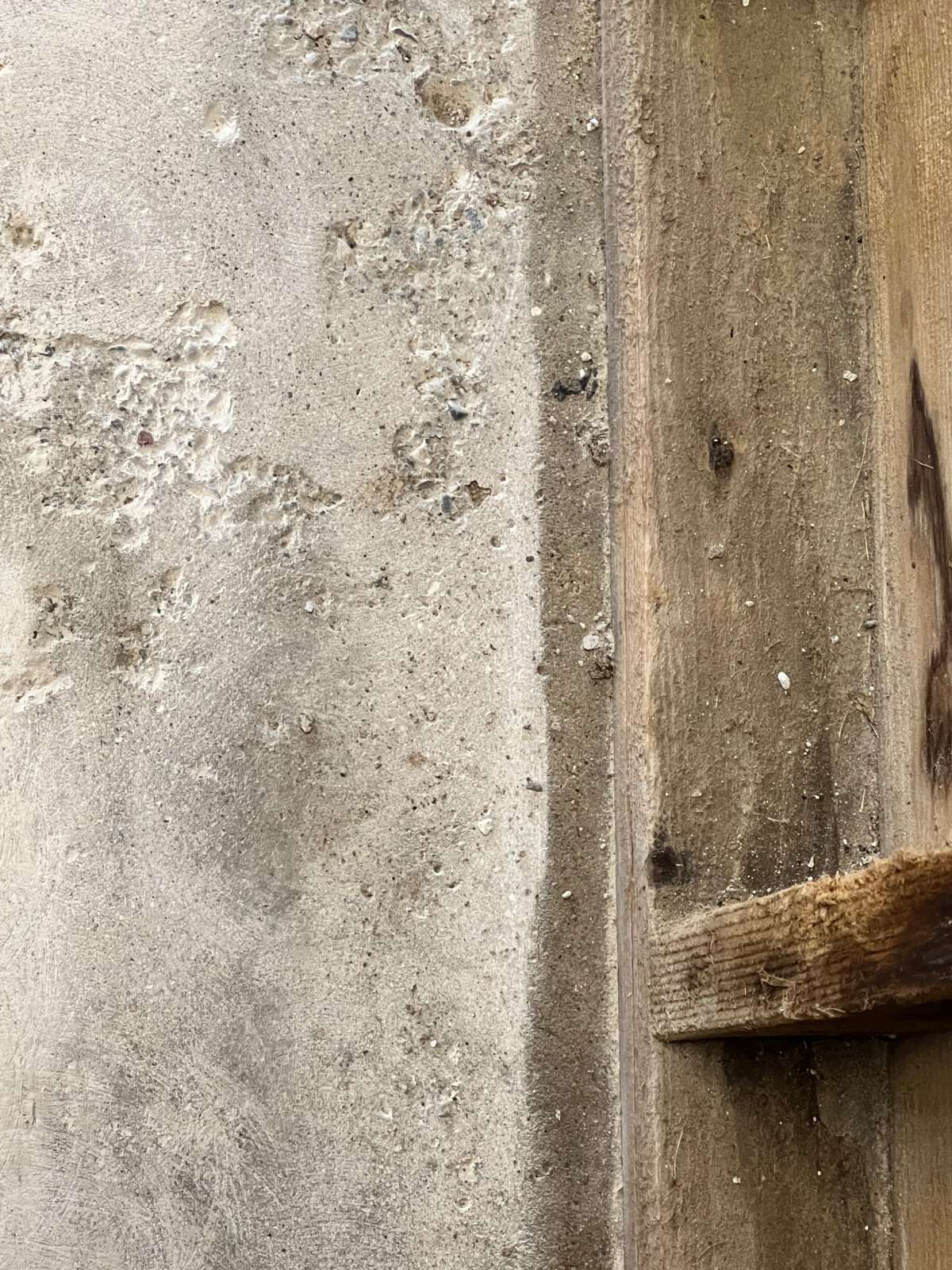
On Highland Avenue, we found one of the more damaged 336-square-foot slabs our crew has worked on: heavy cracks running in multiple directions, some with exposed aggregate along the crack faces, plus oil staining and pooled fluid clustered around the crack zones. Multi-directional cracking with exposed aggregate is precisely what a brittle coating telegraphs through within a few seasons — the crack pattern shows up again on the surface as the slab keeps moving underneath it. We treated the oil contamination with an MR-50 emulsifier before grinding, since grinding alone leaves petroleum trapped in the pore structure, then diamond-ground the full slab, packed every crack and pitted zone with mender compound, and applied our polyurea-polyaspartic system in Smoke, a medium grey flake blend. We disclosed to the homeowner up front that the coating warranty covers the system, not the underlying structural crack movement — an honest distinction that matters regardless of which material goes down.

Massoit Road — A Prior Coating Removed
A third Clawson project, on Massoit Road, involved an 872-square-foot slab carrying a worn painted coating and broad patches of efflorescence and mineral deposits. We ground through the failing surface to clean concrete, repaired the cracking and pitting underneath, and applied our MC-4.2 system in Slate Stone, a cool blue-grey blend, carrying the coating to the driveway edge. It’s a reminder that whatever goes down on a Clawson garage floor eventually needs to come off again if it turns out to be the wrong specification for what the slab is doing — a cost most homeowners don’t plan for the first time around.
Epoxy vs. Polyurea-Polyaspartic, Side by Side
| Epoxy | Polyurea-Polyaspartic | |
|---|---|---|
| Upfront cost, installed | $4.50–$8.50/sq ft ($2,000–$3,500, 2-car garage) | $6–$12/sq ft ($2,800–$5,000, 2-car garage) |
| Cure / return-to-service time | Typically several days, longer in cold weather | As little as 24 hours |
| Flexibility under slab movement | Rigid — can crack or telegraph existing cracks | Flexible — moves with the slab |
| UV stability | Prone to yellowing and ambering with sun exposure | Formulated to resist UV yellowing |
| Moisture tolerance | Vulnerable to bubbling and adhesion loss from vapor | More tolerant, especially with a moisture barrier |
| Resistance to road salt | Can lose adhesion under repeated salt exposure | Built for Michigan freeze-thaw and salt exposure |
| Expected service life (SE Michigan) | 7–15 years professional; 1–3 years DIY kit | 15–20 years |
| Who can install it | Widely available, including DIY kits | Requires a trained crew — no DIY route |
For the chemistry behind these differences, see why polyurea-polyaspartic coatings outperform epoxy.
Cost
A firm price before we’ve inspected your slab would be misleading. What decides the number is the condition of the concrete underneath, not just the square footage. Our North Bywood Avenue job needed straightforward new-concrete profiling and perimeter seam repair on 537 square feet. Our Highland Avenue job, at 336 square feet, needed oil emulsifier treatment plus extensive multi-directional crack and pitting repair before any coating could go down. Those aren’t the same job, and they can’t carry the same number.
What Moves the Price on a Clawson Garage
- Removing a prior coating — our Massoit Road project required grinding through a full painted surface before repair could begin.
- The depth of crack and pitting repair — Highland Avenue needed mender worked into cracks running in multiple directions, not a single patch.
- Oil extraction — Highland Avenue’s oil staining needed MR-50 emulsifier treatment before grinding could proceed.
| Item | Range |
|---|---|
| Professional epoxy, installed | $4.50–$8.50 per sq ft |
| Professional epoxy, typical 2-car garage | $2,000–$3,500 |
| Polyurea/polyaspartic, installed | $6–$12 per sq ft |
| Polyurea/polyaspartic, typical 2-car garage | $2,800–$5,000 |
| Difference between the two on the same garage | roughly $1,000–$1,500 |
| DIY epoxy kit, 2-car garage | $150–$650 |
| Removing a failed coating | $2–$4 per sq ft (roughly $800–$1,800 on a 2-car garage) |
| Service life, professional epoxy (SE Michigan) | 7–15 years |
| Service life, polyurea/polyaspartic (SE Michigan) | 15–20 years |
| Service life, DIY water-based kit | 1–3 years |
A “typical 2-car garage” runs 400–500 square feet. Epoxy is cheaper on day one. MotorCity’s own records include a documented counter-example: a 15-year-old epoxy floor that yellowed and lost adhesion at the control joints, so the second installation had to absorb a removal cost the first one avoided. Day-one savings and lifetime cost aren’t the same comparison.
Michigan Conditions
A Clawson garage floor goes through freeze-thaw cycling every winter, road salt tracked in on tires and boots, and UV exposure at the apron where the garage meets the driveway. Epoxy is a strong performer in a climate-controlled interior industrial floor with no UV and no freeze-thaw — that’s where most of its track record comes from. An attached, unheated Clawson garage is a different environment, and it’s where the failures we document across our case studies — yellowing, adhesion loss at control joints, delamination — tend to show up on schedule.
FAQ
A 20×20 garage is 400 square feet, within the typical 2-car garage range. Professional epoxy runs $4.50–$8.50 per square foot installed, or roughly $2,000–$3,500 total — before accounting for what’s already on the slab. On our Highland Avenue project in Clawson, a 336-square-foot garage needed oil emulsifier treatment and extensive crack repair before any coating could go down, which adds real cost beyond the base square-footage rate. A DIY epoxy kit runs $150–$650 for a 2-car garage but typically lasts only 1–3 years in Michigan conditions, versus 7–15 years for a professional installation.
A typical 2-car garage in the Detroit metro runs 400–500 square feet. Professional epoxy costs $2,000–$3,500 installed; polyurea-polyaspartic runs $2,800–$5,000 — a difference of roughly $1,000–$1,500 on the same garage. The final number depends on slab condition, not just square footage. Our North Bywood Avenue project in Clawson, a 537-square-foot garage in a house still under construction, needed straightforward new-concrete profiling and perimeter seam repair. Our Massoit Road project, at 872 square feet, needed a full painted coating ground off before repair and coating could begin — a different job entirely, priced differently.
Epoxy is a rigid coating, so it telegraphs cracks rather than flexing with the slab — exactly the failure mode we found at our Highland Avenue project in Clawson, where cracks ran in multiple directions with exposed aggregate along the crack faces. Epoxy can also yellow under UV exposure at a garage apron, lose adhesion under freeze-thaw cycling and road salt, and needs the concrete to finish curing and off-gassing before it bonds reliably — a problem on new pours like our North Bywood Avenue project, where the slab was still releasing moisture. Professional epoxy installations in SE Michigan run 7–15 years; DIY kits typically last only 1–3 years.
For an unheated Detroit-metro garage, a polyurea-polyaspartic system rates highest for durability — 15–20 years in SE Michigan conditions versus 7–15 years for professional epoxy. It cures fast: our crew’s MC-3.8 system on North Bywood Avenue in Clawson had that new-construction garage ready to use within a day, on a slab that was still moving. It’s also flexible enough to handle the kind of multi-directional cracking we found at our Highland Avenue project, rather than telegraphing it back through the surface. The trade-off is cost: polyaspartic runs $6–$12 per square foot installed against $4.50–$8.50 for epoxy, and it requires a trained crew rather than a DIY kit.
See the Full Installations
All three projects are documented in full, with before-and-after photos, on our Clawson garage floor coating page.
Compare Coatings in Nearby Cities
The same comparison, worked through with garages documented in neighbouring cities:
- Coating a garage floor in Royal Oak: epoxy or polyaspartic?
- Coating a garage floor in Troy: epoxy or polyaspartic?
For the metro-wide picture — cost ranges, service life, and how each material handles a Michigan winter — see epoxy garage floor coating compared with polyurea-polyaspartic across Metro Detroit.
Get a Quote for Your Clawson Garage
Every price on this page is a market range, not a quote. What your project costs depends on what’s actually on your slab. Call 248-613-5888 for a free inspection and an accurate number.
MotorCity Floors and Coatings
46101 Grand River Ave, Novi, MI 48374
248-613-5888 · [email protected]