 Skip to content
Epoxy Garage Floor Coating in Metro Detroit — A Comparison with Polyurea-Polyaspartic Systems
QUESTIONS? NEED A QUOTE?
Which Coating Belongs on a Detroit-Area Garage Floor?
For an attached, unheated garage anywhere in the Detroit metro, a polyurea-polyaspartic system is the better specification, and an epoxy garage floor coating is the cheaper one. Both halves of that sentence are true, which is why the choice is worth thinking about rather than assuming.
Epoxy costs roughly $4.50 to $8.50 per square foot installed against $6 to $12 for polyaspartic — about $1,000 to $1,500 apart on the same two-car garage. What the extra buys is tolerance for the conditions a Michigan garage actually imposes: freeze-thaw cycling every winter, road salt carried in on tires and boots, sunlight at the apron, and a slab that moves. Epoxy is rigid, yellows under UV, and needs concrete that has finished curing before it will bond. In a climate-controlled warehouse none of that matters. In a garage in Livonia or Troy, all of it does.
Epoxy and Polyurea-Polyaspartic, Side by Side
| Epoxy | Polyurea-Polyaspartic | |
|---|---|---|
| Upfront cost, installed | $4.50–$8.50/sq ft ($2,000–$3,500, 2-car garage) | $6–$12/sq ft ($2,800–$5,000, 2-car garage) |
| Cure / return-to-service time | Typically several days, longer in cold weather | As little as 24 hours |
| Flexibility under slab movement | Rigid — can crack or telegraph existing cracks | Flexible — moves with the slab |
| UV stability | Prone to yellowing and ambering with sun exposure | Formulated to resist UV yellowing |
| Moisture tolerance | Vulnerable to bubbling and adhesion loss from vapor | More tolerant, especially with a moisture barrier |
| Resistance to road salt | Can lose adhesion under repeated salt exposure | Built for Michigan freeze-thaw and salt exposure |
| Expected service life (SE Michigan) | 7–15 years professional; 1–3 years DIY kit | 15–20 years |
| Who can install it | Widely available, including DIY kits | Requires a trained crew — no DIY route |
The chemistry behind these differences is set out in full on why polyurea-polyaspartic coatings outperform epoxy. The short version: epoxy cures into a hard, rigid film, and polyaspartic cures into a flexible one that keeps moving with the concrete underneath it.
What These Coatings Cost in Metro Detroit
A firm price before anyone has looked at the slab would be misleading. What decides the number is the condition of what is already down there, not the square footage on its own.
Two documented jobs make the point. A garage on Centennial Street in St. Clair Shores had no prior coating and went straight to profiling. A Sterling Heights garage needed a failed epoxy removed across 352 square feet, plus three steps with treads and risers. Those are not the same job and cannot carry the same number, even at a similar size.
What Moves the Price
- Removing a prior coating. A failed epoxy or a painted surface has to come off before anything can go back on.
- A moisture barrier, where water is moving up through the slab.
- The depth of crack and pitting repair. A single patch is not the same as mender worked into cracks running in several directions.
- Walls, steps and other vertical surfaces, which are priced separately from floor area.
- Oil extraction. Grinding alone leaves petroleum trapped in the pore structure; contaminated slabs need an emulsifier treatment first.
| Item | Range |
|---|---|
| Professional epoxy, installed | $4.50–$8.50 per sq ft |
| Professional epoxy, typical 2-car garage | $2,000–$3,500 |
| Polyurea/polyaspartic, installed | $6–$12 per sq ft |
| Polyurea/polyaspartic, typical 2-car garage | $2,800–$5,000 |
| Difference between the two on the same garage | roughly $1,000–$1,500 |
| DIY epoxy kit, 2-car garage | $150–$650 |
| Removing a failed coating | $2–$4 per sq ft (roughly $800–$1,800 on a 2-car garage) |
| Service life, professional epoxy (SE Michigan) | 7–15 years |
| Service life, polyurea/polyaspartic (SE Michigan) | 15–20 years |
| Service life, DIY water-based kit | 1–3 years |
Epoxy is cheaper to install. It is not automatically the cheaper floor. A Milford garage in MotorCity’s records carried a 15-year-old epoxy that had yellowed and lost adhesion at the control joints — so the second installation had to absorb a removal cost, at $2 to $4 per square foot, that the first one avoided. Day-one savings and lifetime cost are two different comparisons, and only one of them shows up on the first quote.
What a Michigan Garage Does to a Coating
An unheated attached garage in southeast Michigan is a harder environment than most floor coatings are tested for. The slab goes through freeze-thaw cycling all winter, expanding and contracting while a rigid film on top of it does not. Road salt arrives on every vehicle and sits in meltwater against the coating for months. At the apron, where the garage meets the driveway, the floor gets direct sunlight that the rest of the slab never sees.
Epoxy’s track record comes largely from interior industrial floors — climate controlled, no UV, no salt, no seasonal movement. That record is real, and it stops applying at the garage door. The failure patterns documented across MotorCity’s case studies are that mismatch arriving on schedule: yellowing at the apron, adhesion loss at control joints, delamination, and crack patterns telegraphing back through the surface.
What the Documented Projects Show
Among the metro-area projects MotorCity has documented, three recurring situations decide the material more than anything a brochure says.
New concrete that is still moving. A slab poured within the last few months keeps releasing moisture and keeps shifting. That is the condition a rigid film handles worst — blistering, adhesion loss, or cracking along with the slab.
Slabs already cracked in several directions. Multi-directional cracking with exposed aggregate is what a brittle coating telegraphs through within a few seasons. The crack pattern reappears on the surface as the concrete keeps moving underneath.
A previous coating that failed. These are the jobs where the first specification’s real cost finally lands, because removal has to be paid for before the replacement is even quoted.
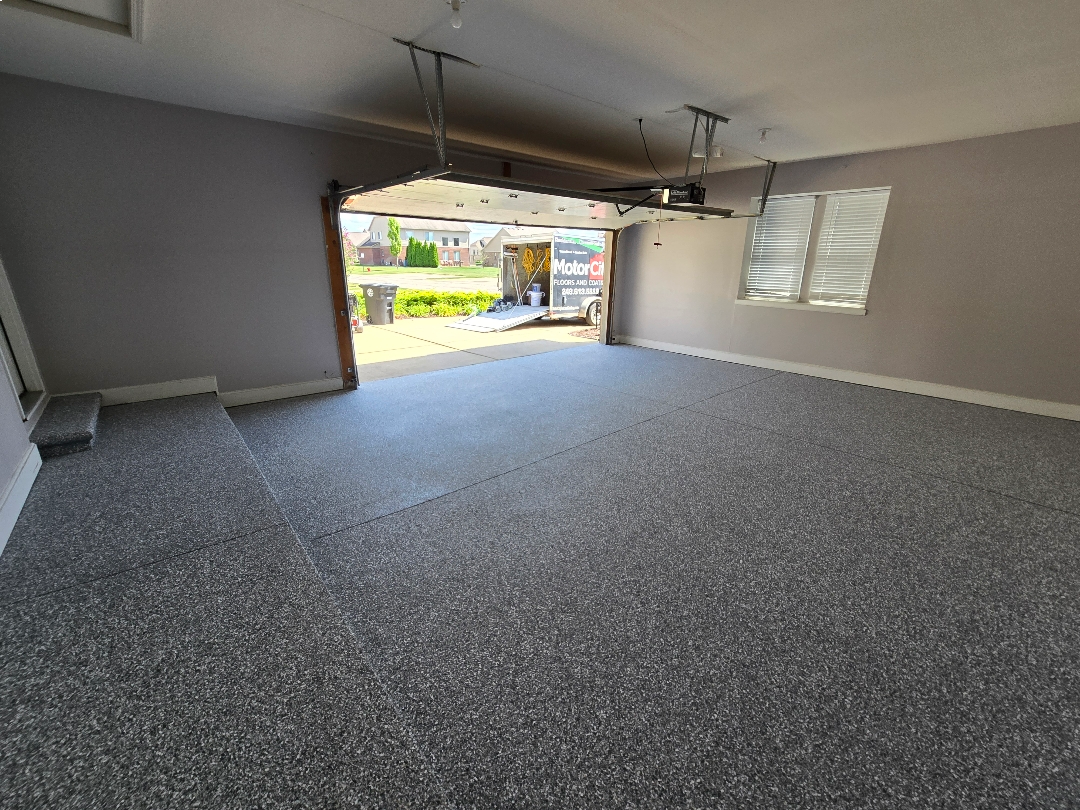
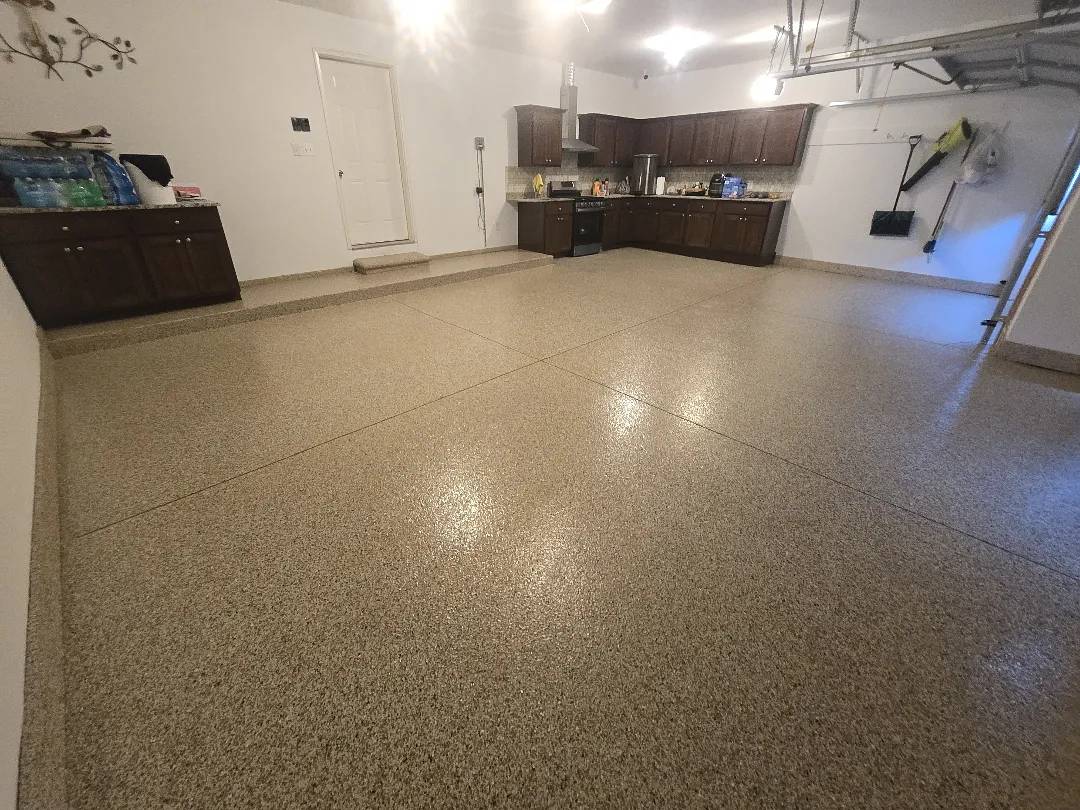
The city pages below document these situations street by street, with square footages, slab conditions, and before-and-after photographs.

FAQ
Polyaspartic, for an unheated garage in this climate. The deciding factors are freeze-thaw movement, road salt, and UV at the apron — the three conditions epoxy handles worst. A polyurea-polyaspartic system stays flexible as the slab expands and contracts, is formulated to resist UV yellowing, and holds adhesion under repeated salt exposure. Expected service life in southeast Michigan runs 15 to 20 years, against 7 to 15 for a professional epoxy installation and 1 to 3 for a DIY water-based kit. Epoxy remains a sound specification for a climate-controlled interior floor with no UV and no seasonal movement; an attached Michigan garage is not that environment.
Not reliably. A polyurea-polyaspartic system requires full diamond grinding down to clean, open concrete, which means an existing epoxy has to come off rather than be coated over. Removal runs roughly $2 to $4 per square foot, or about $800 to $1,800 on a typical two-car garage of 400 to 500 square feet, and it is paid before the new coating is quoted. Coating over a failing epoxy inherits whatever is wrong underneath: if the old film has lost adhesion at the control joints, the new surface fails in the same places on the same schedule.
A polyurea-polyaspartic system is usually a one-day installation, with the floor back in service within about 24 hours. Professional epoxy typically needs several days to cure, and longer in cold weather, because cure time depends on temperature. That difference matters most on a garage someone actually needs to use. It is worth separating from preparation time, though: a slab needing oil extraction, deep crack repair, or removal of a failed coating adds work before any coating goes down, whichever material is specified.
Usually because they are not quoting the same job. Square footage is the easy part; what varies is how much preparation each quote includes. A quote that assumes a clean slab and light profiling will always look better than one that includes diamond grinding, oil extraction with an emulsifier, mender worked into cracks and pitted zones, or removal of a prior coating. It is also worth asking which material is being priced — professional epoxy runs $4.50 to $8.50 per square foot installed and polyurea-polyaspartic $6 to $12, so two quotes can differ by $1,000 to $1,500 on the same garage before preparation is counted at all.
Compare Epoxy and Polyurea in Your City
Each page below works through the same comparison using garages documented in that city — what the slab was doing, what it needed before coating, and what went down.
- Epoxy concrete floor coating in Ann Arbor compared with polyaspartic
- Epoxy floor coating in Auburn Hills compared with polyaspartic systems
- Epoxy floor coating in Clawson compared with a polyaspartic system
- Epoxy floor coating in Farmington Hills compared with a polyaspartic system
- Epoxy floor coating in Livonia compared with polyurea coating
- Epoxy concrete floor coating in Macomb compared with a polyaspartic installation
- Epoxy concrete floor coating in Milford compared with a polyurea installation
- Epoxy garage floor coating in Northville compared with a polyaspartic system
- Epoxy concrete floor coating in Plymouth compared for homeowners
- Epoxy floor coating in Pontiac compared with a polyurea installation
- Epoxy floor coating in Rochester Hills compared with polyurea coating
- Epoxy garage floor coating in Royal Oak compared with a polyaspartic installation
- Epoxy garage floor coating in Sterling Heights compared with polyurea
- Epoxy concrete floor coating in Troy compared with polyurea coating
- Epoxy concrete floor coating in Utica compared with a polyaspartic installation
- Epoxy garage floor coating in Ypsilanti compared with polyurea
More cities are being added. The full library of installations, with before-and-after photographs, is on the Michigan garage floor coating case studies page.
Get a Quote for Your Garage
Every figure on this page is a regional market range, not a quote. What your project costs depends on what is actually on your slab, which is why the inspection comes first. Call 248-613-5888 for a free inspection and an accurate number.
MotorCity Floors and Coatings
46101 Grand River Ave, Novi, MI 48374
248-613-5888 · [email protected]