
Epoxy Floor Coating in Livonia — Comparison with Polyurea Coating
QUESTIONS? NEED A QUOTE?
Epoxy Floor Coating in Livonia: The Answer
For a Detroit-metro garage, a polyurea-polyaspartic system holds up better than epoxy over the long run — it resists the freeze-thaw cycling and road salt that break epoxy’s bond over time, and it cures fast enough to use the garage the next day. Epoxy costs less upfront and is easy to find as a DIY kit, but that lower price is exactly what turned into a second bill on two Livonia garage floors MotorCity had to strip and recoat after the original epoxy failed. The trade-off is real: epoxy is cheaper on day one, polyurea-polyaspartic is the system built to survive a Michigan winter.
What We Actually Found in Livonia
Two Livonia projects MotorCity has documented show what happens when epoxy’s weaknesses catch up with it — one coating that stained and cracked its way to failure, another that delaminated outright.
Levan Road — 468 Sq Ft, Failed Epoxy, an Oil-Stained Anteroom, and Cracking
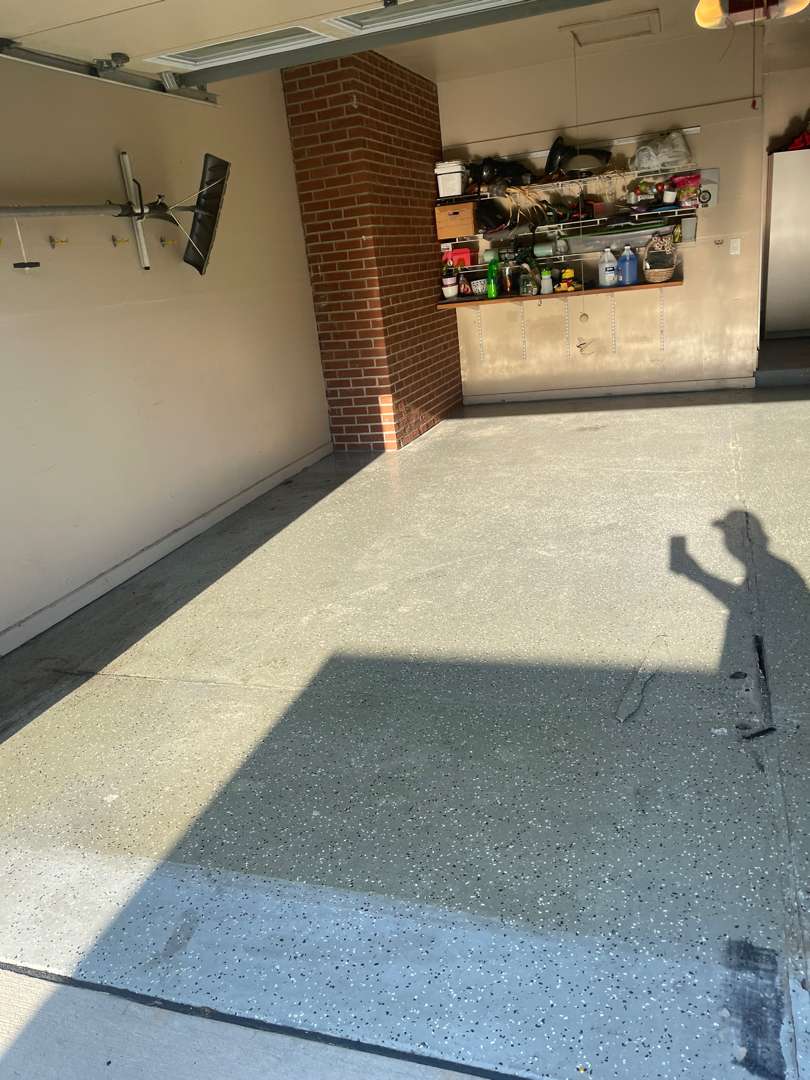
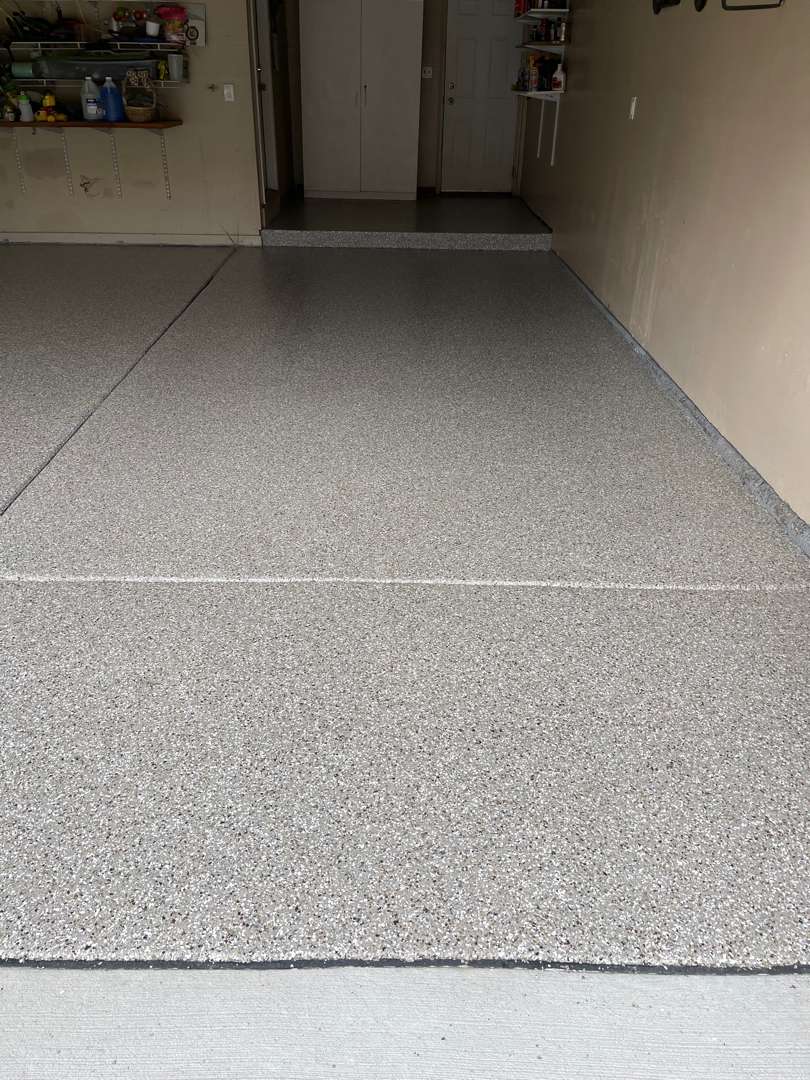
On Levan Road, a 468-square-foot garage floor and adjoining anteroom had already been through one coating cycle. The existing epoxy was staining and degrading, no longer protecting the concrete underneath, and in the small anteroom off the main garage, oil contamination had soaked through and left dark, spreading stains that cleaning alone couldn’t fix. Moisture testing came back at 3.8% — well within normal range, so the concrete itself wasn’t the problem. What was: a significant diagonal crack running across the main parking area, smaller fractures near the base of a brick column, and a main seam where old caulk had failed and needed to come out entirely. Because the existing epoxy had to go first, our crew used 36-grit diamond tooling rather than the 24-grit used on bare concrete — aggressive enough to strip the old coating and expose clean, bondable concrete underneath. Every crack was opened, cleaned, and filled flush, and the failed caulk was dug out of the seam rather than coated over. The scope included 8 linear inches of vertical lip along the base of the walls; no steps were involved. The crew applied a polyurea base coat with Pebble Beach flake — a warm, light grey with beige undertones — across the main garage and into the anteroom, sealing the oil-stained concrete under one continuous, impermeable surface.
Summers Street — 420 Sq Ft, Red Flake Epoxy Fully Removed
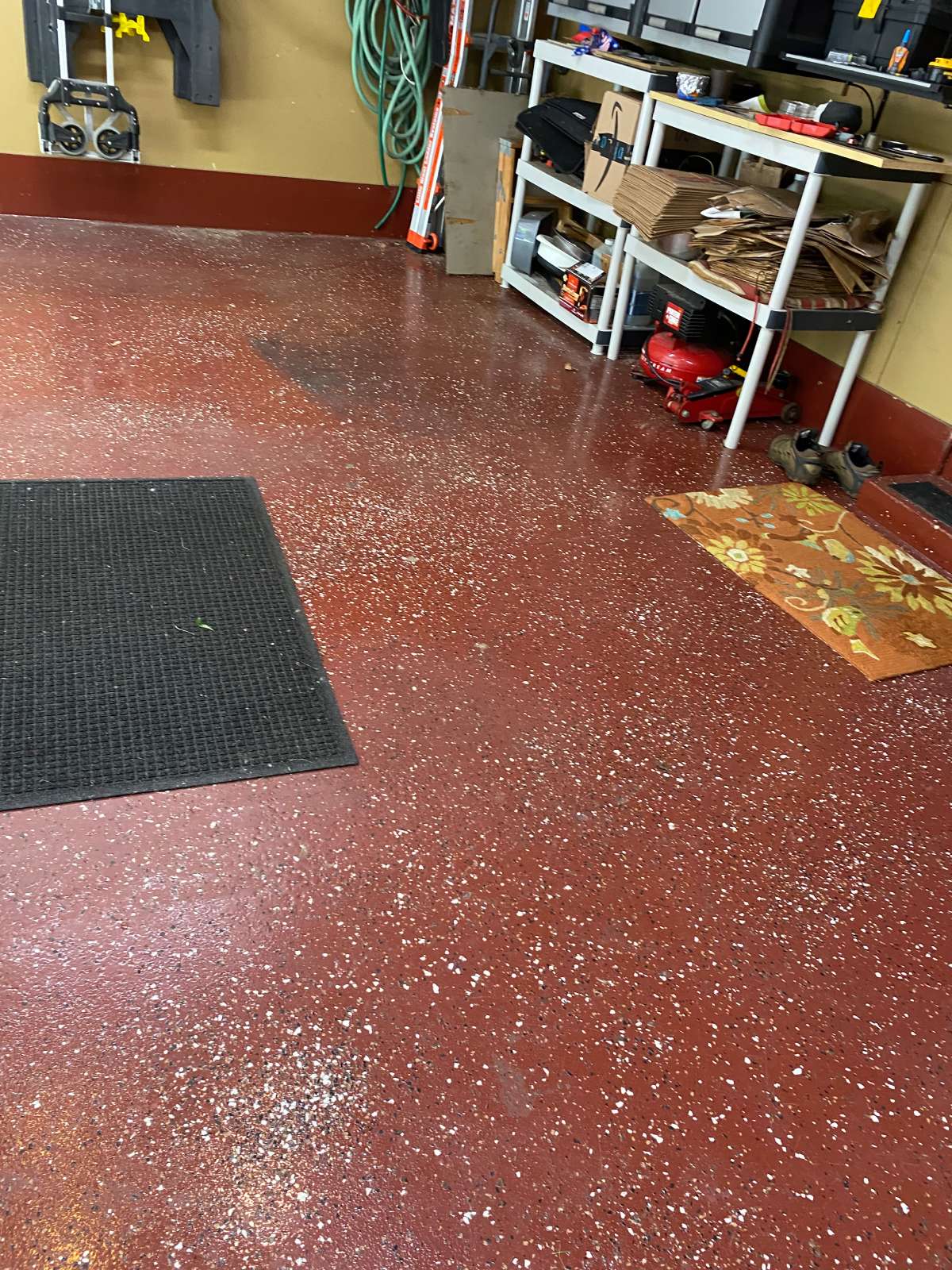
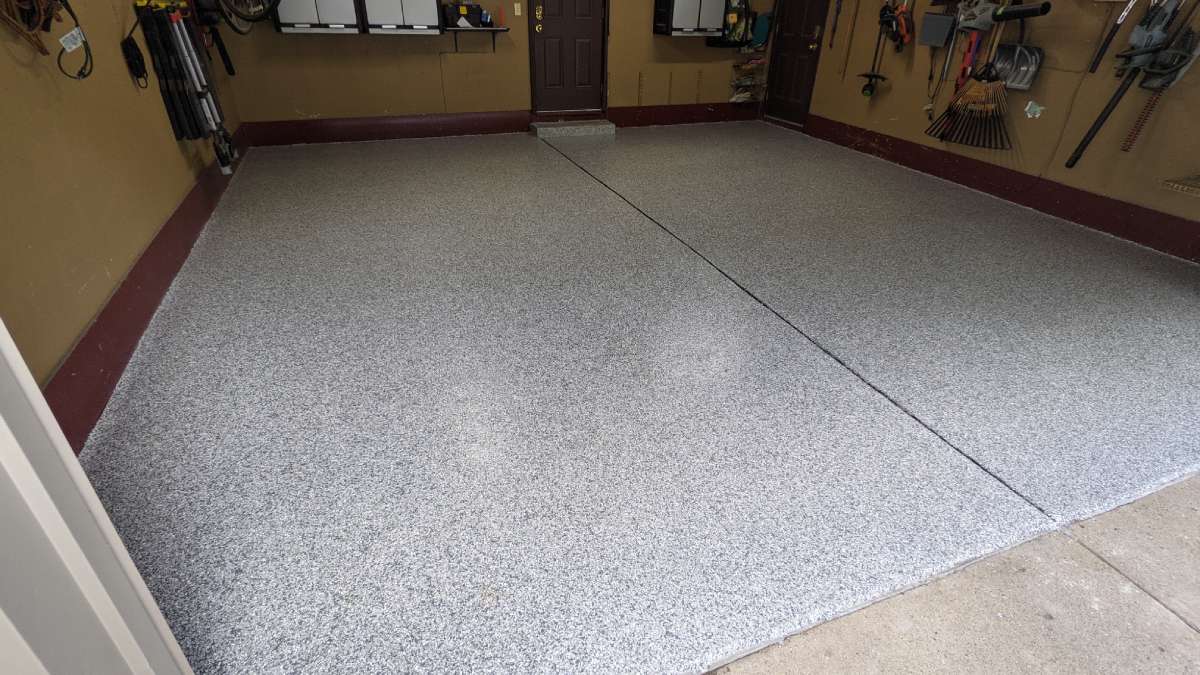
On Summers Street, a 420-square-foot garage floor carried a red flake epoxy system that had already failed. The red base coat had separated in places, and white flake chips from the original installation had lifted loose and scattered across the surface — the coating was no longer bonded to anything. Rather than coat over a delaminating system, which would only have meant bonding to old epoxy instead of concrete, our crew diamond-ground the full 420 square feet to strip it entirely, down to grey, uniformly profiled concrete. One control joint crack ran the length of the floor; it was filled with polyurea filler and feathered flush with the surrounding slab. Beyond that single crack, repairs were limited — no flood coat, no leveling work, just a clean, profiled surface ready for coating. The homeowner chose Slatestone, a cooler, more architectural grey-dominant blend, over the warm-toned epoxy it replaced. The crew applied an MR-50 base coat, broadcast the Slatestone flake, and sealed everything with a polyaspartic clear topcoat in a single coating day.
Both projects trace back to the same failure mode: an epoxy coating that couldn’t hold its bond over time, whether through staining and cracking at Levan Road or outright delamination at Summers Street. Among the Livonia projects MotorCity has documented, both required a full removal of the original epoxy before a polyurea-polyaspartic system could go down.
Epoxy or Polyurea-Polyaspartic, Side by Side
| Epoxy | Polyurea-Polyaspartic | |
|---|---|---|
| Upfront cost, installed | $4.50–$8.50/sq ft ($2,000–$3,500, 2-car garage) | $6–$12/sq ft ($2,800–$5,000, 2-car garage) |
| Cure / return-to-service time | Typically several days, longer in cold weather | Often next-day |
| Flexibility under slab movement | Rigid — can crack or telegraph existing cracks | Flexible — moves with the slab |
| UV stability | Prone to yellowing and ambering with sun exposure | Formulated to resist UV yellowing |
| Bond to properly prepped concrete | Depends heavily on prep quality | More forgiving of minor prep variance |
| Resistance to road salt | Can lose adhesion under repeated salt exposure | Built for Michigan freeze-thaw and salt exposure |
| Expected service life (SE Michigan) | 7–15 years professional; 1–3 years DIY kit | 15–20 years |
| Who can install it | Widely available, including DIY kits | Requires a trained crew — no DIY route |
For the chemistry behind these differences, see why polyurea-polyaspartic coatings outperform epoxy.
Cost
A firm price before we’ve inspected your slab would be misleading. What decides the number is the condition of what’s already on the concrete, not just the square footage. Our Levan Road job needed a failed epoxy coating stripped from 468 square feet plus an adjoining anteroom, crack repair, and a caulk-seam rebuild. Our Summers Street job needed a full removal of a delaminated red flake epoxy system across 420 square feet, with more limited repairs beyond that.
What Moves the Price on a Livonia Garage
- Removing a prior coating — both Levan Road’s failing epoxy and Summers Street’s delaminated red flake system had to come off before anything new could go down.
- Crack and joint repair — Levan Road’s diagonal crack, smaller fractures, and failed caulk seam needed individual attention beyond a standard grind.
- Oil-contaminated areas — the anteroom at Levan Road required the same profiling and coating treatment as the main garage to seal the stained concrete.
| Item | Range |
|---|---|
| Professional epoxy, installed | $4.50–$8.50 per sq ft |
| Professional epoxy, typical 2-car garage | $2,000–$3,500 |
| Polyurea/polyaspartic, installed | $6–$12 per sq ft |
| Polyurea/polyaspartic, typical 2-car garage | $2,800–$5,000 |
| Difference between the two on the same garage | roughly $1,000–$1,500 |
| DIY epoxy kit, 2-car garage | $150–$650 |
| Removing a failed coating | $2–$4 per sq ft (roughly $800–$1,800 on a 2-car garage) |
| Service life, professional epoxy (SE Michigan) | 7–15 years |
| Service life, polyurea/polyaspartic (SE Michigan) | 15–20 years |
| Service life, DIY water-based kit | 1–3 years |
A “typical 2-car garage” runs 400–500 square feet — close to both Levan Road and Summers Street’s actual size. Epoxy is cheaper on day one, but both Livonia projects are the counter-example in MotorCity’s own records: a first epoxy installation that failed, and a second installation that had to absorb the removal cost the first one avoided. Day-one savings and lifetime cost are not the same comparison.
Michigan Conditions
A Livonia garage floor goes through the same freeze-thaw cycling, road salt, and daily vehicle traffic as anywhere else in the Detroit metro, and Livonia’s housing stock spans decades — from postwar ranches to newer subdivision construction — so the concrete our crews find varies as much as the coatings applied to it over the years. Epoxy can perform well when it’s installed correctly, but it demands precise surface preparation and has little margin for error: skip the diamond grinding, leave a crack unaddressed, or coat over failed caulk, and the coating eventually lets go regardless of how sound the concrete underneath is. That’s exactly what happened at both Levan Road and Summers Street — normal, healthy moisture readings under coatings that had failed anyway, because the failure was about the coating and its installation, not the slab.
FAQ
A 20×20 garage is 400 square feet, close to the size of both our Levan Road (468 sq ft) and Summers Street (420 sq ft) projects in Livonia. Professional epoxy runs $4.50–$8.50 per square foot installed, or roughly $2,000–$3,500 total. On the Summers Street project, the 420-square-foot garage needed a delaminated red flake epoxy system fully stripped before any new coating could go down, which adds real cost beyond the base square-footage rate.
Prices in the Detroit metro area tend to vary from $2,000–$3,500 for a professional epoxy installation on a typical two-car garage of 400–500 square feet, and from $2,800–$5,000 for a polyurea-polyaspartic system. Those are regional ranges and do not change from one city to the next. Actual quotes are provided after a visual inspection of the concrete to be coated, because the process changes with the state of the slab. Among the Livonia garages MotorCity has documented, one needed a staining, degrading epoxy coating removed across 468 square feet, with diagonal crack and caulk-seam repair and an oil-contaminated anteroom sealed. Another, at 420 square feet, needed a delaminated red flake epoxy taken off and its control joints repaired. Same city, different work, different numbers.
Epoxy needs a properly profiled, contaminant-free, crack-free slab to hold its bond, and if any of that is missing, the coating eventually stains, cracks, or delaminates outright — exactly what MotorCity’s crew found at two Livonia garages: a staining, degrading epoxy over cracked concrete at Levan Road, and a red flake system that had separated and scattered loose chips across the floor at Summers Street. In both cases, the original coating had to be fully diamond-ground off before a new system could bond properly.
For an unheated Detroit-metro garage, a polyurea-polyaspartic system rates highest for durability — 15–20 years in SE Michigan conditions versus 7–15 years for professional epoxy. It’s also more forgiving during installation: at MotorCity’s Levan Road project in Livonia, the crew coated a main garage plus an oil-stained anteroom as one continuous, properly bonded system. The trade-off is cost: polyaspartic runs $6–$12 per square foot installed against $4.50–$8.50 for epoxy, and it requires a trained crew rather than a DIY kit.
See the Full Installations
Both projects are among the Livonia projects MotorCity has documented. Read the full case studies, with before-and-after photos, on our Livonia garage floor coating page — see the full Levan Road and Summers Street installations.
Compare Coatings in Nearby Cities
The same comparison, worked through with garages documented in neighbouring cities:
- Coating a garage floor in Plymouth: epoxy or polyaspartic?
- Coating a garage floor in Northville: epoxy or polyaspartic?
For the metro-wide picture — cost ranges, service life, and how each material handles a Michigan winter — see epoxy garage floor coating compared with polyurea-polyaspartic across Metro Detroit.
Get a Quote for Your Livonia Garage
Every price on this page is a market range, not a quote. What your project costs depends on what’s actually on your slab. Call 248-613-5888 for a free inspection and an accurate number.
MotorCity Floors and Coatings
46101 Grand River Ave, Novi, MI 48374
248-613-5888 · [email protected]