 Skip to content
Epoxy Floor Coating in Farmington Hills — A Comparison with Polyaspartic Systems
QUESTIONS? NEED A QUOTE?
Epoxy Floor Coating in Farmington Hills: The Answer
Two Farmington Hills garages make the case plainly. On Sheffield Drive, pits that a previous contractor had filled with epoxy were only partially holding — some fills intact, others already failing — and the slab still needed a moisture barrier before anything new went down. On Amber Drive, an entire epoxy installation had failed outright: cracked, peeling, spilled onto the driveway, and splattered across the trim. For an unheated Farmington Hills garage, a polyurea-polyaspartic system is the better bet against Michigan’s freeze-thaw and moisture — epoxy costs less upfront, but these two floors show what that savings can cost later.
What We Actually Found in Farmington Hills
Among the Farmington Hills projects MotorCity has documented, one shows a prior epoxy patch job that was only half holding; another shows what a full epoxy failure actually looks like up close.
Sheffield Drive — Partially Failed Epoxy Fills and a Moisture Barrier
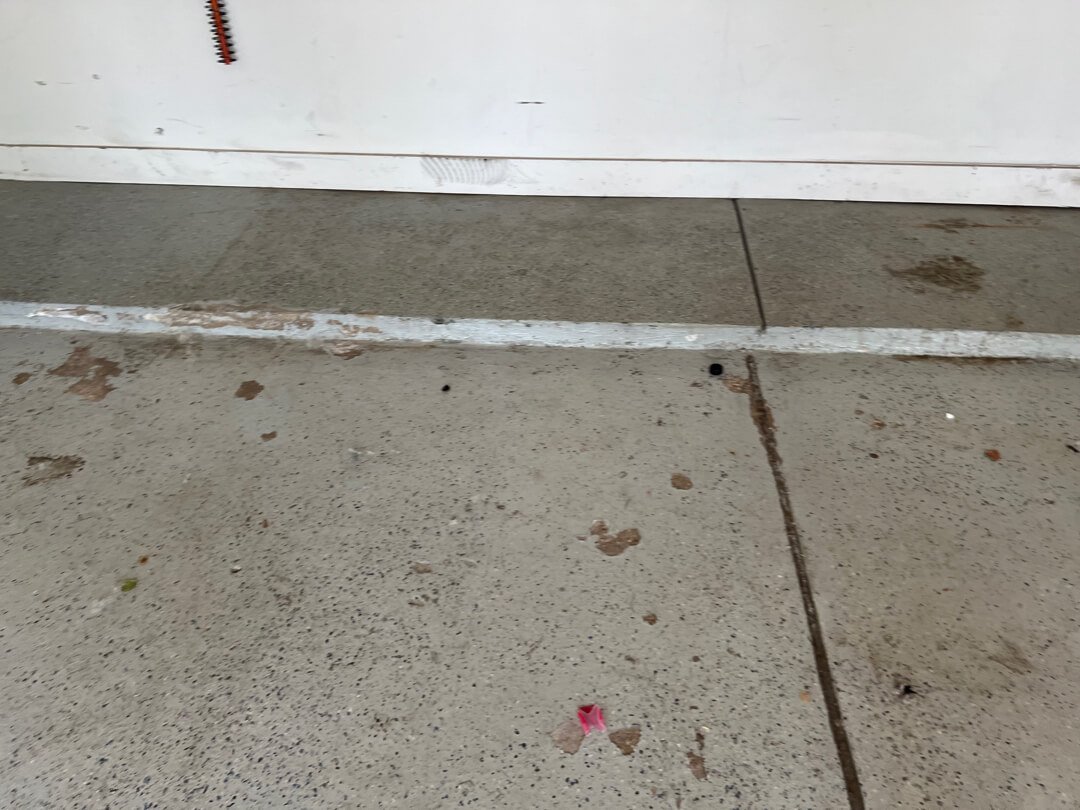
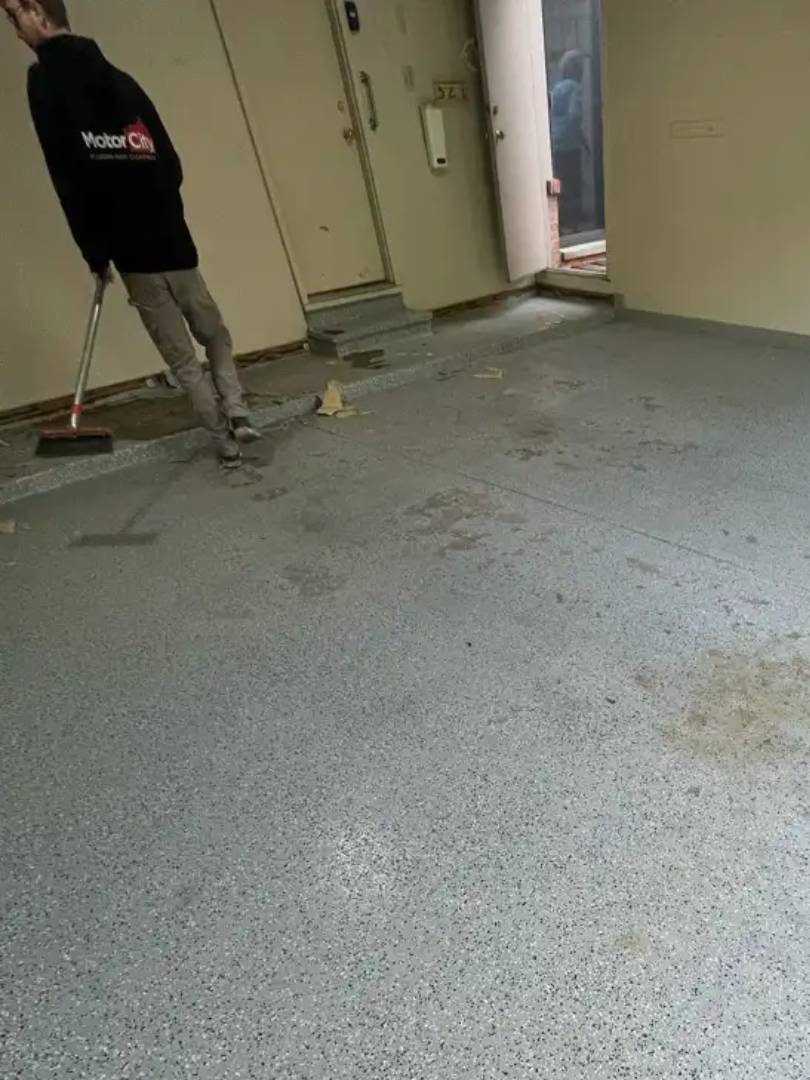
At Sheffield Drive, brown drip marks and grime covered a slab that had already been patched once: narrow, bladed pits scattered across the floor carried epoxy fills from an earlier repair. Some of those fills were still holding. Others had already let go, leaving the pitting exposed again. Even where the old epoxy had held, the concrete still needed proper diamond-ground preparation before a new coating could bond to it — a partial fix doesn’t substitute for full prep. Moisture testing confirmed a barrier was needed before coating, so our crew applied a full moisture barrier coat across the slab before building up the system. A polyurea-polyaspartic base coat went down with a blue-grey flake blend broadcast across it, sealed with a heavy clear topcoat, and carried up and over one concrete step to match the main floor.

Amber Drive — 453 Sq Ft, a Previous Contractor’s Epoxy Failure
Amber Drive was a different kind of job: a full teardown of another contractor’s failed epoxy work. Paint had splattered onto the trim and driveway, decorative flakes were embedded in the baseboards, and the floor itself showed spiderweb cracks radiating from stress points, pitting throughout, and sections of epoxy actively peeling away. The front lip was broken and crumbling. Our crew removed the old caulk and the failed epoxy completely across all 453 square feet, ground out 29 linear feet of contaminated vertical surfaces, and repaired the damaged concrete and broken lip before any new material went down. A Pebble Beach polyurea-polyaspartic system followed, with 36-grit traction added across the full slab, the rebuilt front lip and one wood step coated to match, and the vertical surfaces cleaned and recoated to remove every trace of the previous job.

Both jobs make the same point from opposite directions: a partial epoxy fix that only holds until it doesn’t, and a full epoxy installation that failed outright. Neither is the exception in a Michigan garage — it’s what epoxy’s chemistry does under freeze-thaw and moisture over time.
Epoxy or Polyurea-Polyaspartic, Side by Side
| Epoxy | Polyurea-Polyaspartic | |
|---|---|---|
| Upfront cost, installed | $4.50–$8.50/sq ft ($2,000–$3,500, 2-car garage) | $6–$12/sq ft ($2,800–$5,000, 2-car garage) |
| Cure / return-to-service time | Typically several days, longer in cold weather | As little as 24 hours |
| Flexibility under slab movement | Rigid — can crack or telegraph existing cracks | Flexible — moves with the slab |
| UV stability | Prone to yellowing and ambering with sun exposure | Formulated to resist UV yellowing |
| Moisture tolerance | Vulnerable to bubbling and adhesion loss from vapor | More tolerant, especially with a moisture barrier |
| Resistance to road salt | Can lose adhesion under repeated salt exposure | Built for Michigan freeze-thaw and salt exposure |
| Expected service life (SE Michigan) | 7–15 years professional; 1–3 years DIY kit | 15–20 years |
| Who can install it | Widely available, including DIY kits | Requires a trained crew — no DIY route |
For the chemistry behind these differences, see why polyurea-polyaspartic coatings outperform epoxy.
Cost
A firm price before we’ve inspected your slab would be misleading. What decides the number is the condition of what’s already on the concrete, not just the square footage. Our Sheffield Drive job needed a moisture barrier plus repair of pitting that a prior epoxy fill had only partly held. Our Amber Drive job needed a full failed-epoxy teardown across 453 square feet, including a rebuilt front lip and cleanup of overspray on the trim and baseboards — a different scope entirely.
What Moves the Price on a Farmington Hills Garage
- Removing a prior coating — our Amber Drive project required a full failed-epoxy teardown, including 29 linear feet of contaminated vertical surfaces, before any repair could begin.
- Moisture remediation — Sheffield Drive needed a full moisture barrier application after testing confirmed elevated moisture, a step epoxy fills routinely skip.
- Structural repair — the broken front lip at Amber Drive and the bladed pitting at Sheffield Drive both needed direct repair work beyond a standard grind-and-coat job.
| Item | Range |
|---|---|
| Professional epoxy, installed | $4.50–$8.50 per sq ft |
| Professional epoxy, typical 2-car garage | $2,000–$3,500 |
| Polyurea/polyaspartic, installed | $6–$12 per sq ft |
| Polyurea/polyaspartic, typical 2-car garage | $2,800–$5,000 |
| Difference between the two on the same garage | roughly $1,000–$1,500 |
| DIY epoxy kit, 2-car garage | $150–$650 |
| Removing a failed coating | $2–$4 per sq ft (roughly $800–$1,800 on a 2-car garage) |
| Service life, professional epoxy (SE Michigan) | 7–15 years |
| Service life, polyurea/polyaspartic (SE Michigan) | 15–20 years |
| Service life, DIY water-based kit | 1–3 years |
A “typical 2-car garage” runs 400–500 square feet. Epoxy is cheaper on day one. But at Sheffield Drive, that day-one savings only bought a partial fix — some of the old epoxy fills had already failed by the time we arrived. And at Amber Drive, the previous contractor’s epoxy job had to be torn out completely before anything could be done right. Day-one savings and lifetime cost are not the same comparison.
Michigan Conditions
A Farmington Hills garage floor goes through freeze-thaw cycling every winter, road salt tracked in on tires and boots, and — as both Sheffield Drive and Amber Drive show — real risk from a coating that was never suited to the climate in the first place. Epoxy performs well in a climate-controlled interior industrial floor with no UV, no freeze-thaw, and no moisture vapor pushing up from the ground. An attached, unheated Farmington Hills garage is a different environment entirely, and it’s where the failures we document — pitting fills that only partly held, an entire epoxy installation that failed and had to be torn out — tend to show up regardless of how carefully the original installation was done.
FAQ
A 20×20 garage is 400 square feet, within the typical 2-car garage range. Professional epoxy runs $4.50–$8.50 per square foot installed, or roughly $2,000–$3,500 total. On our Amber Drive project in Farmington Hills, a 453-square-foot garage needed a previous contractor’s failed epoxy completely torn out — including 29 linear feet of contaminated vertical surfaces and a rebuilt front lip — before any new coating could go down, which adds real cost beyond the base square-footage rate.
A typical 2-car garage in the Detroit metro runs 400–500 square feet. Professional epoxy costs $2,000–$3,500 installed; polyurea-polyaspartic runs $2,800–$5,000 — a difference of roughly $1,000–$1,500 on the same garage. Our Sheffield Drive project in Farmington Hills needed a full moisture barrier application plus repair of pitting where a prior epoxy fill had only partly held — a larger scope than a straightforward job of the same size.
Epoxy is a rigid coating that’s vulnerable to moisture pushing up through the slab, and patch fills can fail over time rather than holding permanently — exactly what we found at our Sheffield Drive project in Farmington Hills, where some earlier epoxy pit fills were still intact and others had already let go. It can also fail outright: at our Amber Drive project, a previous contractor’s full epoxy installation had cracked, peeled, and had to be torn out completely. Professional epoxy installations in SE Michigan run 7–15 years; DIY kits typically last only 1–3 years.
Yes — epoxy fills don’t always hold permanently, and when they let go, the pitting they were meant to seal comes back. At our Sheffield Drive project in Farmington Hills, some earlier epoxy fills in bladed pitting were still intact while others had already failed, and the slab also tested positive for moisture requiring a barrier coat before any new coating went down. A polyurea-polyaspartic system bonds directly to properly prepared concrete rather than patching over old material, and at 15–20 years of expected service life in SE Michigan versus 7–15 years for professional epoxy, it’s built to outlast the kind of partial fix that started failing at Sheffield Drive.
See the Full Installations
Both projects are documented in full, with before-and-after photos, on our Farmington Hills garage floor coating page — see the full Sheffield Drive and Amber Drive installations.
Compare Coatings in Nearby Cities
The same comparison, worked through with garages documented in neighbouring cities:
- Coating a garage floor in Northville: epoxy or polyaspartic?
- Coating a garage floor in Livonia: epoxy or polyaspartic?
For the metro-wide picture — cost ranges, service life, and how each material handles a Michigan winter — see epoxy garage floor coating compared with polyurea-polyaspartic across Metro Detroit.
Get a Quote for Your Farmington Hills Garage
Every price on this page is a market range, not a quote. What your project costs depends on what’s actually on your slab. Call 248-613-5888 for a free inspection and an accurate number.
MotorCity Floors and Coatings
46101 Grand River Ave, Novi, MI 48374
248-613-5888 · [email protected]