 Skip to content
Epoxy Garage Floor Coating in Sterling Heights — How It Compares with Polyurea
QUESTIONS? NEED A QUOTE?
Epoxy or Polyurea for a Sterling Heights Garage?
When comparing epoxy garage floor coating in Sterling Heights to polyurea-polyaspartic, two of the most damaged slabs among the Sterling Heights projects MotorCity has documented share one thing in common: a previous epoxy coating that failed first. That is a pattern showing up across Macomb County garages, not a marketing claim. Epoxy costs less to install and is available as a DIY kit; polyurea-polyaspartic costs more and needs a trained crew. But when a slab already carries a failed epoxy coating, chipping and delaminating across every panel, or when a DIY kit’s shallow bond has broken down entirely, a flexible, mechanically-bonded system solves a problem epoxy created in the first place.
What We Actually Found in Sterling Heights
Among the Sterling Heights projects MotorCity has documented, two tell the epoxy story directly.
Ashton Drive — A Failed Epoxy Coating, Floor and Steps
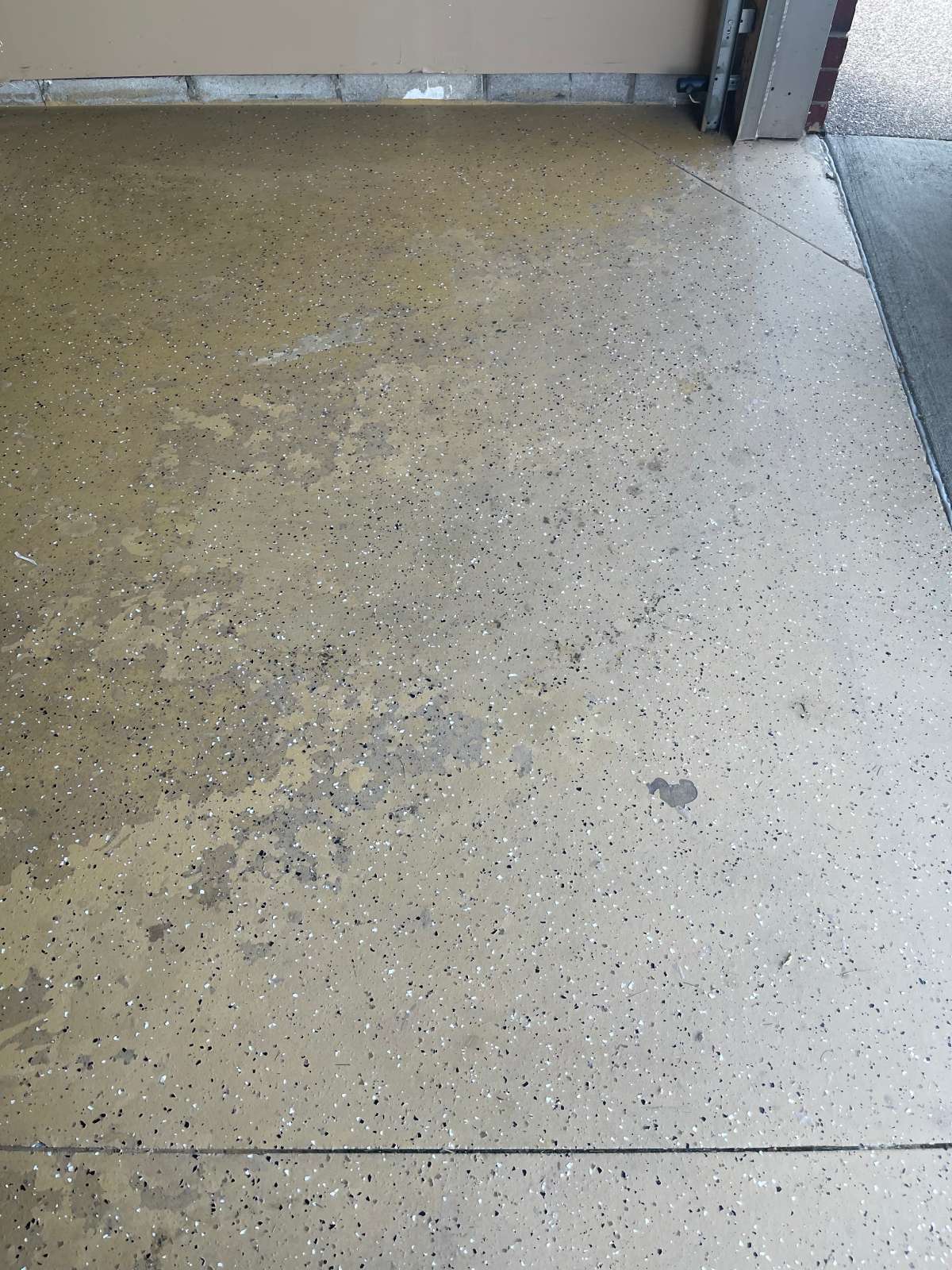
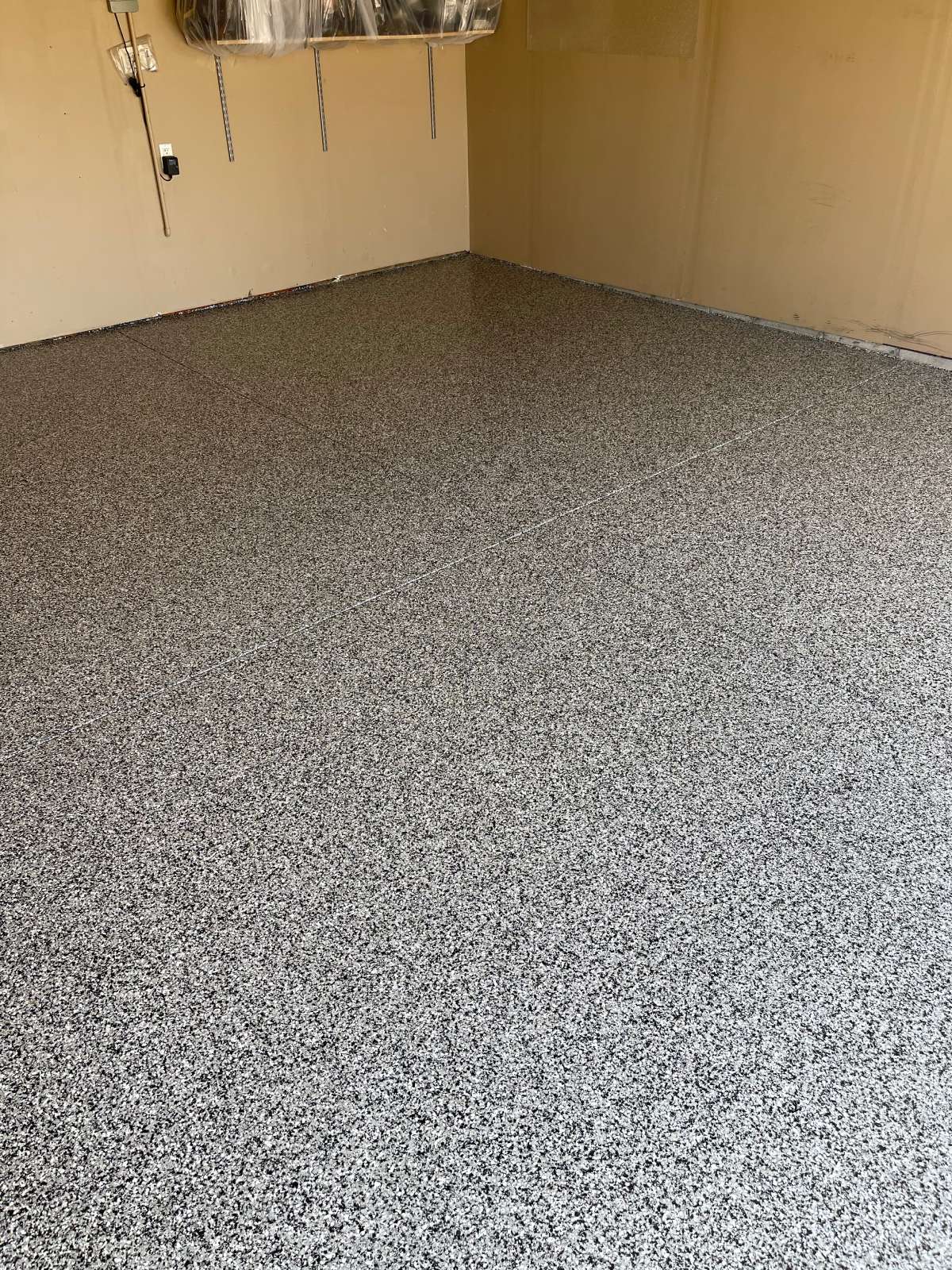
At Ashton Drive, a previous epoxy coating covered the full 352-square-foot slab — and it had failed throughout. Chipping, delaminating, and lifting spread across all four panels, with the concrete underneath in worse shape than the surface suggested: pitting throughout and several cracks running through the slab. The failure did not stop at the floor. Three steps at the rear carried the same failed epoxy on both treads and risers. Removing it was not simple surface prep — residual coating left behind blocks a new system from bonding at all. MotorCity’s crew diamond-ground the full slab to strip the epoxy completely, which exposed the pitting and cracks the old coating had been sitting over, packed every crack with cementitious patching compound, ran a second grind pass to bring the surface flush, then applied a polyurea base coat in Domino flake across all four panels and all three steps, finished with a 36-grit polyaspartic topcoat.
Park View Court — When a DIY Epoxy Kit Fails
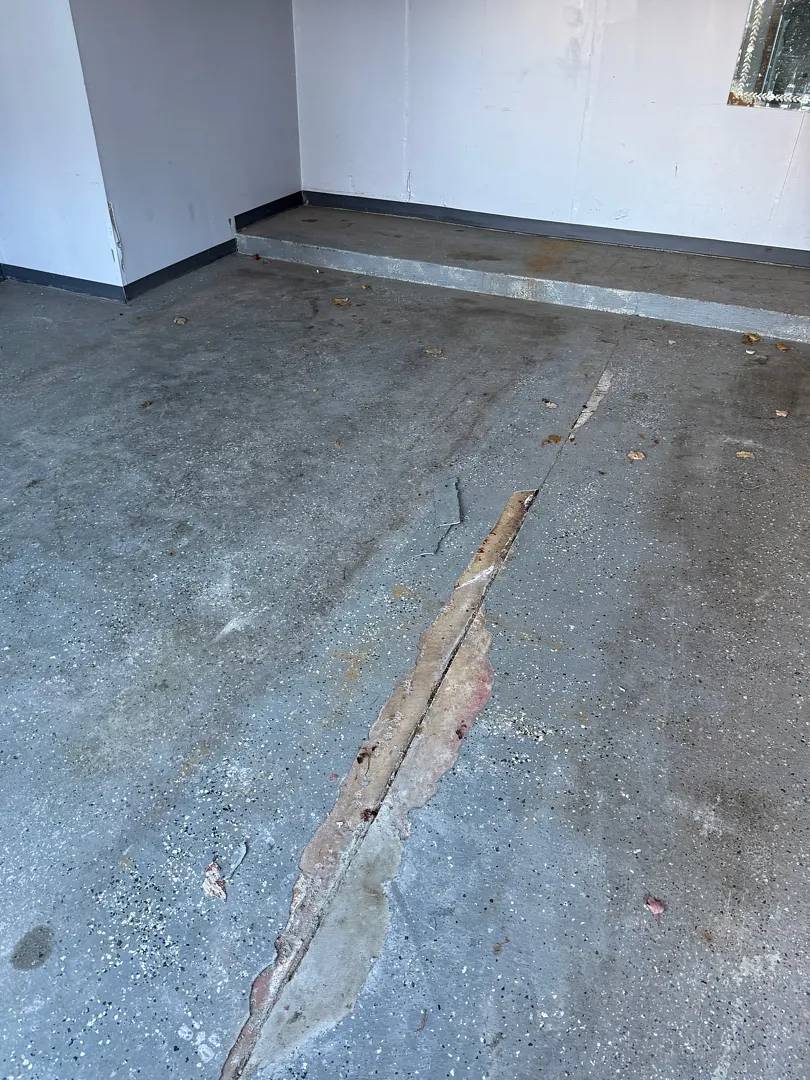
At Park View Court, the problem started the same way but from a DIY kit rather than a professional install. A DIY epoxy coating had been applied across the full 503-square-foot floor and had failed everywhere — worn through, delaminating, offering no real protection. DIY epoxy tends to fail for a specific reason: it relies on acid-etching instead of mechanical diamond grinding for surface preparation, and acid-etching does not open the concrete’s pore structure the way grinding does. The bond stays shallow, and vehicle traffic, Michigan freeze-thaw cycling, and fluid exposure break it down from there. Underneath the failed DIY coating, Park View Court’s slab carried heavy pitting and a large diagonal crack where an old filler repair had buckled and separated along its entire length — evidence the crack was still moving under whatever had been patched over it. MotorCity’s crew diamond-ground the full 503 square feet to strip the DIY epoxy and expose the damage beneath it, packed the crack with flexible polyurea filler rather than a rigid patch, flooded the full slab with Mender epoxy to fill the widespread pitting, then ran a second grind pass before applying an MC-2.9 polyurea base in Stoney Creek flake and a 36-grit polyaspartic topcoat.

Both jobs required removing a failed coating before any new system could go down — a cost neither homeowner planned for the first time around.
Epoxy or Polyurea-Polyaspartic, Side by Side
| Epoxy | Polyurea-Polyaspartic | |
|---|---|---|
| Upfront cost, installed | $4.50–$8.50/sq ft ($2,000–$3,500, 2-car garage) | $6–$12/sq ft ($2,800–$5,000, 2-car garage) |
| Cure / return-to-service time | Typically several days, longer in cold weather | As little as 24 hours |
| Flexibility under slab movement | Rigid — can crack or telegraph existing cracks | Flexible — moves with the slab |
| UV stability | Prone to yellowing and ambering with sun exposure | Formulated to resist UV yellowing |
| Moisture tolerance | Vulnerable to bubbling and adhesion loss from vapor | More tolerant, especially with a moisture barrier |
| Resistance to road salt | Can lose adhesion under repeated salt exposure | Built for Michigan freeze-thaw and salt exposure |
| Expected service life (SE Michigan) | 7–15 years professional; 1–3 years DIY kit | 15–20 years |
| Who can install it | Widely available, including DIY kits | Requires a trained crew — no DIY route |
For the chemistry behind these differences, see why polyurea-polyaspartic coatings outperform epoxy.
Cost
A firm price before we’ve inspected your slab would be misleading. What decides the number is the condition of what’s already on the concrete, not just the square footage. Our Ashton Drive job needed full epoxy removal across 352 square feet plus three steps before any new system could bond. Our Park View Court job needed DIY epoxy removal, a flexible-filler crack repair, and a full-slab Mender flood across 503 square feet — different scope, different price.
What Moves the Price on a Sterling Heights Garage
- Removing a prior coating — both our Ashton Drive and Park View Court projects required full epoxy removal before repair could even begin.
- The depth of crack repair — Park View Court’s diagonal crack needed a flexible filler and a full-slab Mender flood, not a single patch.
- Oil extraction — at Jason Court, also in Sterling Heights, oil staining required MR-50 emulsifier treatment beyond a standard grind-and-coat job.
| Item | Range |
|---|---|
| Professional epoxy, installed | $4.50–$8.50 per sq ft |
| Professional epoxy, typical 2-car garage | $2,000–$3,500 |
| Polyurea/polyaspartic, installed | $6–$12 per sq ft |
| Polyurea/polyaspartic, typical 2-car garage | $2,800–$5,000 |
| Difference between the two on the same garage | roughly $1,000–$1,500 |
| DIY epoxy kit, 2-car garage | $150–$650 |
| Removing a failed coating | $2–$4 per sq ft (roughly $800–$1,800 on a 2-car garage) |
| Service life, professional epoxy (SE Michigan) | 7–15 years |
| Service life, polyurea/polyaspartic (SE Michigan) | 15–20 years |
| Service life, DIY water-based kit | 1–3 years |
A “typical 2-car garage” runs 400–500 square feet. Epoxy is cheaper on day one. MotorCity’s own records include a documented counter-example: a 15-year-old epoxy floor that yellowed and lost adhesion at the control joints, so the second installation had to absorb a removal cost the first one avoided. Day-one savings and lifetime cost are not the same comparison.
Michigan Conditions
A Sterling Heights garage floor goes through freeze-thaw cycling every winter, road salt tracked in on tires and boots, and UV exposure at the apron. Epoxy performs well in a climate-controlled interior industrial floor with no UV and no freeze-thaw — that is where most of its track record comes from. An attached, unheated Sterling Heights garage is a different environment, and it is where the failures we document — chipping, delamination, and coatings that never really bonded — tend to show up on schedule.
FAQ
A 20×20 garage is 400 square feet, within the typical 2-car garage range. Professional epoxy runs $4.50–$8.50 per square foot installed, or roughly $2,000–$3,500 total — before accounting for what’s already on the slab. On our Ashton Drive project in Sterling Heights, a 352-square-foot garage needed full epoxy removal across the floor and three steps before any new coating could go down, which adds real cost beyond the base square-footage rate. A DIY epoxy kit runs $150–$650 for a 2-car garage but typically lasts only 1–3 years in Michigan conditions, versus 7–15 years for a professional installation.
A typical 2-car garage in the Detroit metro runs 400–500 square feet. Professional epoxy costs $2,000–$3,500 installed; polyurea-polyaspartic runs $2,800–$5,000 — a difference of roughly $1,000–$1,500 on the same garage. The final number depends on slab condition, not just square footage. Our Park View Court project in Sterling Heights, at 503 square feet, needed a failed DIY epoxy coating stripped, a diagonal crack repaired with flexible filler, and a full-slab Mender flood before coating could begin — a larger scope than a straightforward job of the same size.
Epoxy is a rigid coating, and a DIY kit makes it worse: DIY epoxy relies on acid-etching rather than mechanical diamond grinding for surface prep, so the bond stays shallow and fails under normal use — exactly what we found at our Park View Court project in Sterling Heights, where a DIY coating had worn through and delaminated across the full floor. Even professionally installed epoxy can chip, delaminate, and lift over time, as our crew found at our Ashton Drive project, where a failed epoxy coating covered all four panels and three steps and had to be fully removed before a new system could bond. Professional epoxy installations in SE Michigan run 7–15 years; DIY kits typically last only 1–3 years.
For an unheated Detroit-metro garage, a polyurea-polyaspartic system rates highest for durability — 15–20 years in SE Michigan conditions versus 7–15 years for professional epoxy. It is also flexible enough to bridge a crack rather than sit rigidly over one: at our Park View Court project in Sterling Heights, our crew packed a large diagonal crack with flexible polyurea filler rather than a rigid patch before coating over it. The trade-off is cost: polyaspartic runs $6–$12 per square foot installed against $4.50–$8.50 for epoxy, and it requires a trained crew rather than a DIY kit.
See the Full Installations
Both projects are documented in full, with before-and-after photos, on our Sterling Heights garage floor coating page — see the full Ashton Drive and Park View Court installations.
Compare Coatings in Nearby Cities
The same comparison, worked through with garages documented in neighbouring cities:
- Coating a garage floor in Troy: epoxy or polyaspartic?
- Coating a garage floor in Royal Oak: epoxy or polyaspartic?
For the metro-wide picture — cost ranges, service life, and how each material handles a Michigan winter — see epoxy garage floor coating compared with polyurea-polyaspartic across Metro Detroit.
Get a Quote for Your Sterling Heights Garage
Every price on this page is a market range, not a quote. What your project costs depends on what’s actually on your slab. Call 248-613-5888 for a free inspection and an accurate number.
MotorCity Floors and Coatings
46101 Grand River Ave, Novi, MI 48374
248-613-5888 · [email protected]