 Skip to content
Epoxy Floor Coating in Rochester Hills — Comparison with Polyurea Coating
QUESTIONS? NEED A QUOTE?
Epoxy Floor Coating in Rochester Hills: The Answer
Two Rochester Hills garages tell the same story: epoxy that was installed without the prep work it needed. On Longford Drive, a 556-square-foot floor had a self-installed epoxy coating that was already peeling and delaminating, the direct result of poor original surface preparation. On Snowy Owl Court, a 528-square-foot floor carried a failing epoxy coating that our crew had to remove from a steep driveway approach before anything new could go down. Neither slab had a structural problem underneath — both moisture readings came back at a normal 4%. The epoxy simply never had a real chance to bond. That is the pattern behind epoxy floor coating in Rochester Hills: the failure usually isn’t the concrete, it’s the coating and the prep that went down on top of it, and it’s a pattern homeowners rarely diagnose correctly on their own before calling a crew in to look.
What We Actually Found in Rochester Hills
Among the Rochester Hills projects MotorCity has documented, two required a full removal of a self-installed epoxy coating that had already failed.
Longford Drive — 556 Sq Ft, Peeling Epoxy Removal and Repair
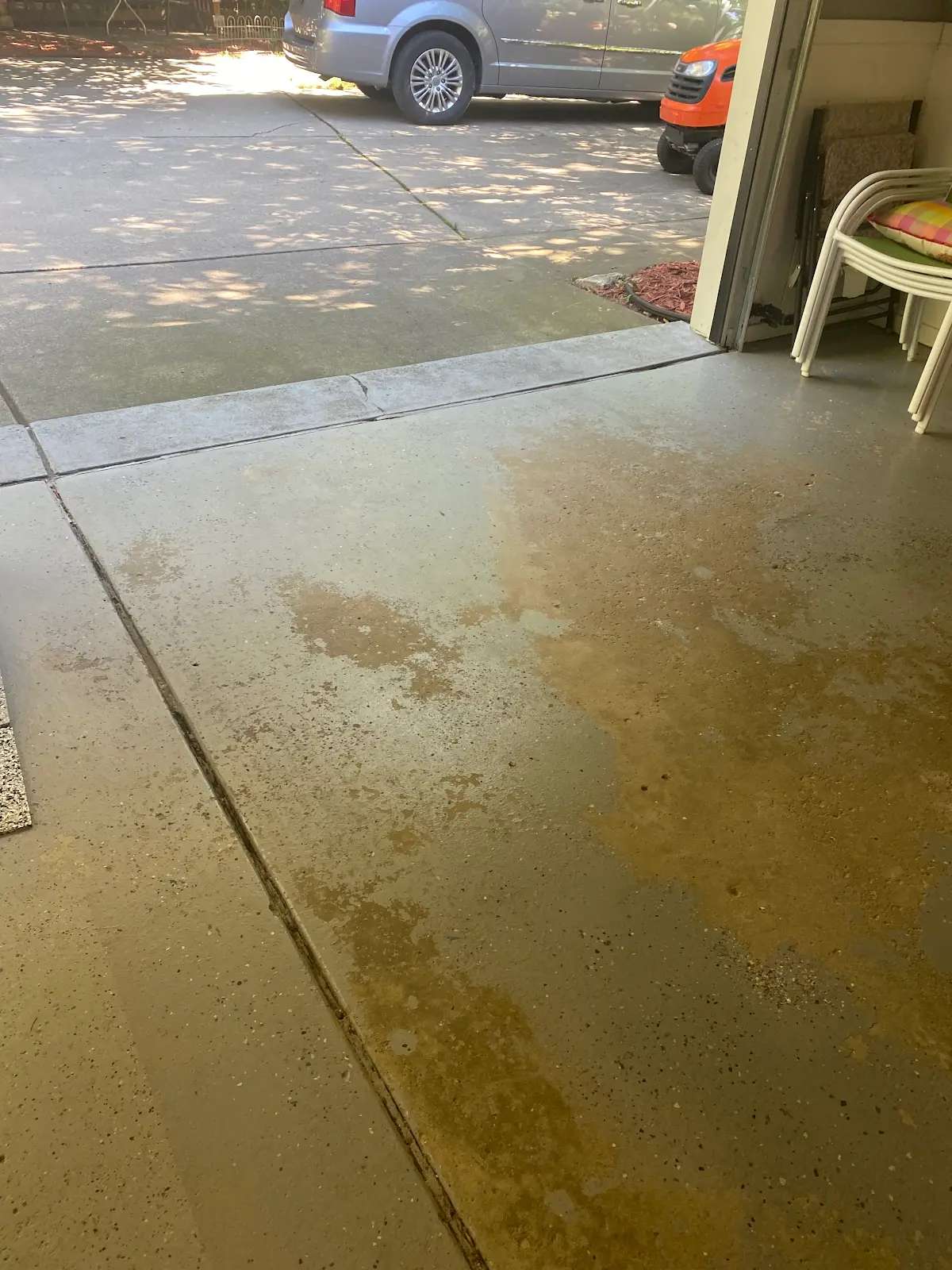
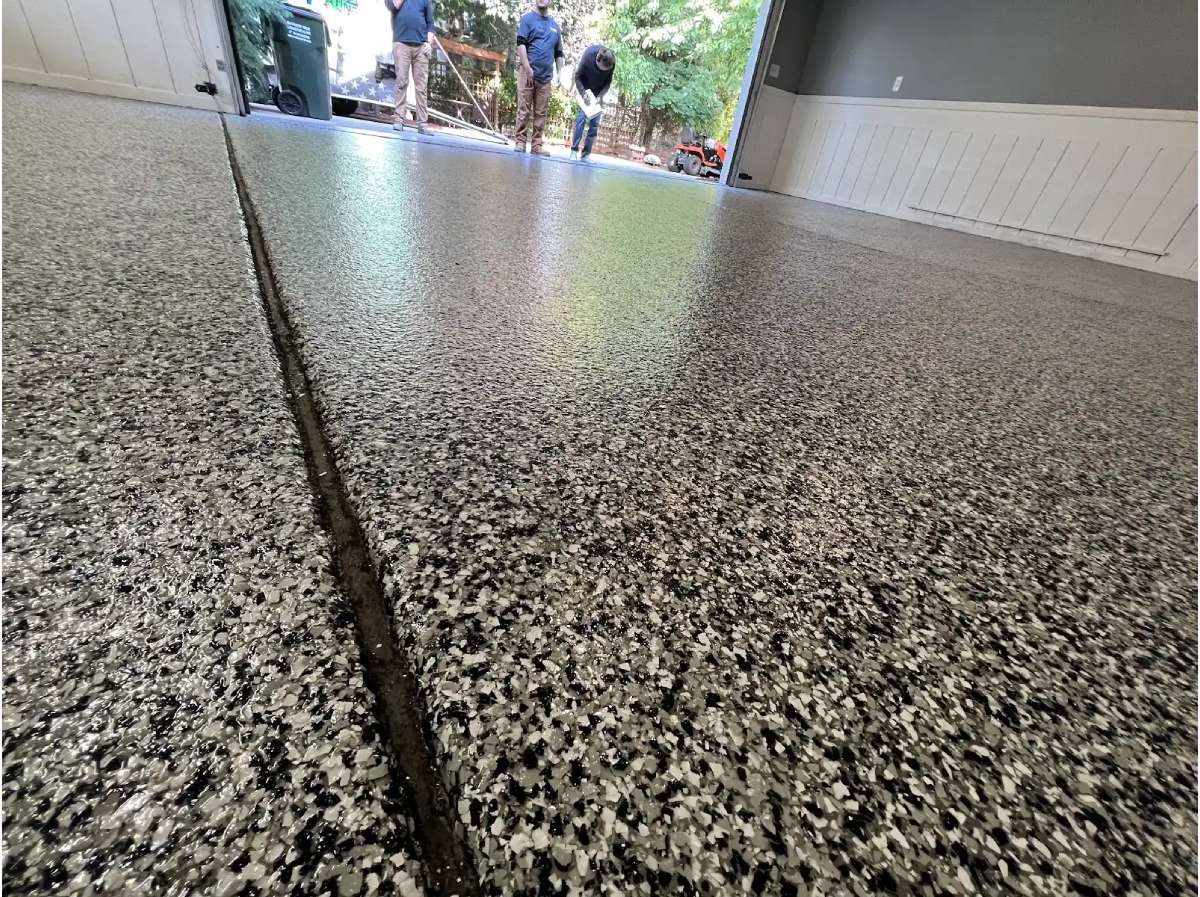
At Longford Drive, the existing epoxy was peeling and delaminating across a 556-square-foot floor — the telltale sign of a coating applied without proper surface preparation, since epoxy needs a properly profiled, contaminant-free slab to bond and this one never got it. Whoever installed the original coating had skipped the mechanical profiling epoxy depends on, and without that anchor, the film had begun lifting at the seams and flaking loose in sheets across large sections of the garage. Our crew diamond-ground the full floor to strip the failing epoxy completely and open the concrete beneath, clearing away the loose material and any remaining adhesive residue in the process. Underneath, the slab showed light pitting concentrated near the vehicle wheel paths and a few expansion joints that needed attention before coating could go down. Mender compound filled the pitting, and each expansion joint was cleaned out and addressed individually so it wouldn’t telegraph through the new system. A moisture test came back at 4% — well within normal range, confirming the failure was about surface prep, not moisture working its way up through the slab. Once the repairs cured, the crew applied a polyurea base coat with Domino (black and white) flake across the full floor, finished with a polyaspartic topcoat carrying 16-grit traction additive for slip resistance.
Snowy Owl Court — 528 Sq Ft, Failed Epoxy Removal on a Steep Driveway
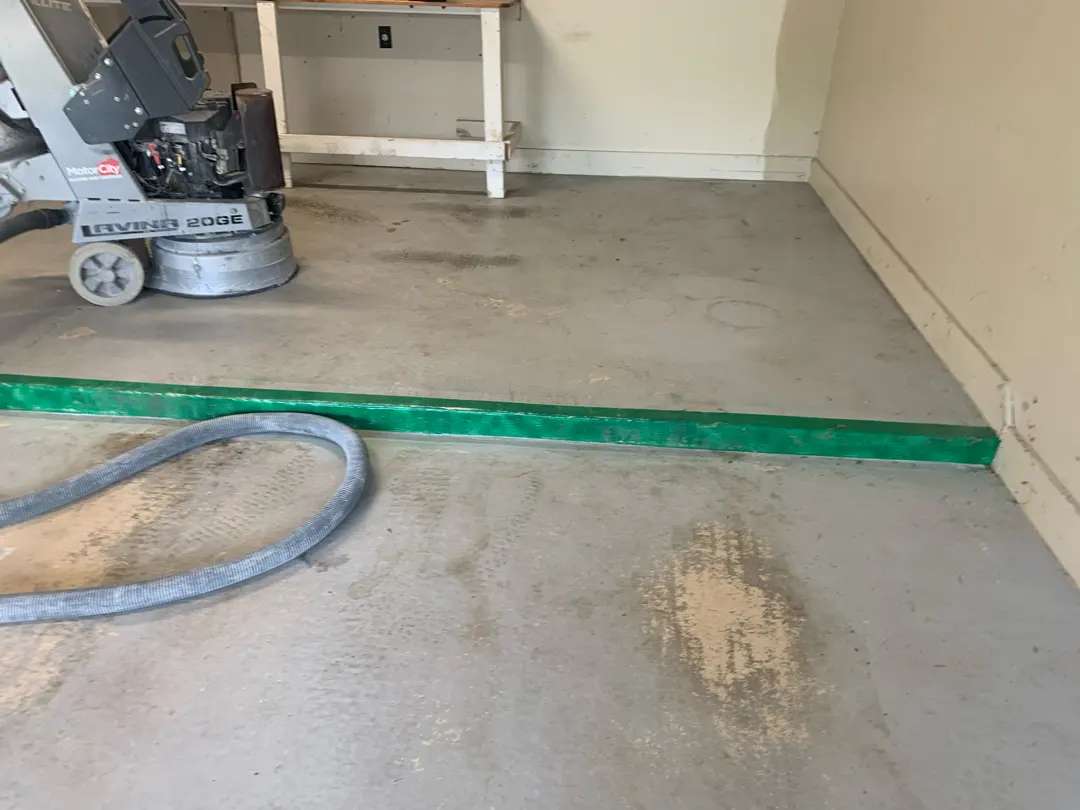
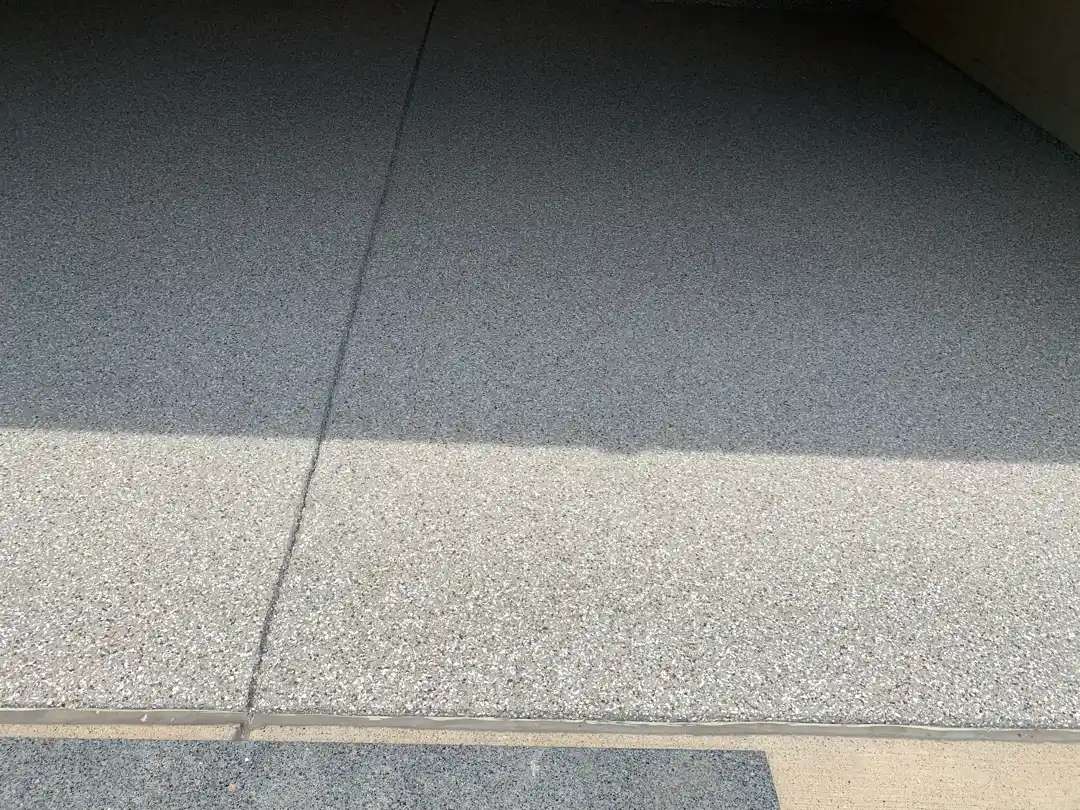
At Snowy Owl Court, a 528-square-foot garage floor had a failing epoxy coating that needed to come off entirely, complicated by a steep driveway approach that made access and material staging more involved than a typical job — equipment and materials had to be carried up an incline rather than rolled straight in from a level driveway. Our crew also removed old, deteriorated caulking at the garage apron as part of the prep, since the failing seal there was letting water track in against the edge of the slab. After diamond-grinding the full floor to strip the epoxy, a moisture test came back at 4%, again confirming a normal, healthy slab underneath a coating that had simply failed. The job’s scope extended well beyond the flat floor: a 20-foot step-up transition area, a 10-foot vertical rise, and one wood step all needed to be brought into the coating system so the whole entry sequence matched the garage floor instead of leaving a bare seam at the threshold. The crew applied a polyurea base coat with Pebble Beach flake across the floor and every one of those transition surfaces, sealed with a polyaspartic topcoat for a uniform, durable finish from the garage floor to the door.
Both jobs point to the same lesson: an epoxy coating is only as good as the prep underneath it, and on these two Rochester Hills slabs, that prep wasn’t there the first time around. Neither slab had a hidden structural issue waiting to be discovered — both tested at a normal 4% moisture — which means a homeowner evaluating either garage before our crew arrived could easily have assumed the concrete itself was the problem. It wasn’t.
Epoxy or Polyurea-Polyaspartic, Side by Side
| Epoxy | Polyurea-Polyaspartic | |
|---|---|---|
| Upfront cost, installed | $4.50–$8.50/sq ft ($2,000–$3,500, 2-car garage) | $6–$12/sq ft ($2,800–$5,000, 2-car garage) |
| Cure / return-to-service time | Typically several days, longer in cold weather | As little as 24 hours |
| Bond to properly prepped concrete | Requires precise surface prep — fails without it | More forgiving bond profile, still needs prep |
| Flexibility under slab movement | Rigid — can crack or telegraph existing cracks | Flexible — moves with the slab |
| UV stability | Prone to yellowing and ambering with sun exposure | Formulated to resist UV yellowing |
| Resistance to road salt | Can lose adhesion under repeated salt exposure | Built for Michigan freeze-thaw and salt exposure |
| Expected service life (SE Michigan) | 7–15 years professional; 1–3 years DIY kit | 15–20 years |
| Who can install it | Widely available, including DIY kits | Requires a trained crew — no DIY route |
For the chemistry behind these differences, see why polyurea-polyaspartic coatings outperform epoxy.
Cost
A firm price before we’ve inspected your slab would be misleading. What decides the number is the condition of what’s already on the concrete, not just the square footage. Our Longford Drive job needed a full epoxy removal across 556 square feet plus pitting and expansion-joint repair. Our Snowy Owl Court job needed a full epoxy removal across 528 square feet plus a 20-foot step-up area, a 10-foot vertical rise, and a wood step brought into the system, on top of a driveway approach steep enough to slow down material staging.
Removing a failed epoxy coating is its own line item, separate from whatever repair work turns up once the old coating is off. On both Rochester Hills jobs, that removal step came first — before pitting could be treated at Longford Drive, or before the step-up area and vertical rise could be prepped at Snowy Owl Court — which is a cost most homeowners don’t budget for when they’re comparing a fresh epoxy quote against a fresh polyurea-polyaspartic quote on paper.
What Moves the Price on a Rochester Hills Garage
- Removing a prior coating — both our Longford Drive and Snowy Owl Court projects required full epoxy removal before any repair could begin.
- Extra scope beyond the floor — the step-up area, vertical rise, and wood step at Snowy Owl Court all needed the same prep and coating as the main slab.
- Site access — the steep driveway approach at Snowy Owl Court added real time to material staging and prep work.
| Item | Range |
|---|---|
| Professional epoxy, installed | $4.50–$8.50 per sq ft |
| Professional epoxy, typical 2-car garage | $2,000–$3,500 |
| Polyurea/polyaspartic, installed | $6–$12 per sq ft |
| Polyurea/polyaspartic, typical 2-car garage | $2,800–$5,000 |
| Difference between the two on the same garage | roughly $1,000–$1,500 |
| DIY epoxy kit, 2-car garage | $150–$650 |
| Removing a failed coating | $2–$4 per sq ft (roughly $800–$1,800 on a 2-car garage) |
| Service life, professional epoxy (SE Michigan) | 7–15 years |
| Service life, polyurea/polyaspartic (SE Michigan) | 15–20 years |
| Service life, DIY water-based kit | 1–3 years |
A “typical 2-car garage” runs 400–500 square feet. Epoxy is cheaper on day one, but at both Longford Drive and Snowy Owl Court, a coating that wasn’t properly prepped the first time meant a full removal bill before anything new could go down. Day-one savings and a coating that actually bonds are not the same thing.
Michigan Conditions
A Rochester Hills garage floor goes through freeze-thaw cycling every winter, road salt tracked in on tires and boots, and daily vehicle traffic. Epoxy can perform well under those conditions when it’s installed correctly — but it demands precise surface preparation to do it, and it has almost no margin for error. Skip the diamond grinding, leave contamination on the surface, or apply it over a slab that wasn’t profiled correctly, and the coating will eventually let go, regardless of how well the concrete underneath was doing. Both Longford Drive and Snowy Owl Court had normal, healthy slabs underneath — 4% moisture on each — which means the epoxy failures on both jobs came down to application, not the concrete. That’s a distinction worth knowing before choosing a coating for a Rochester Hills garage: the material and the installation matter as much as, if not more than, the condition of the slab itself.
FAQ
A 20×20 garage is 400 square feet, within the typical 2-car garage range. Professional epoxy runs $4.50–$8.50 per square foot installed, or roughly $2,000–$3,500 total. On our Longford Drive project in Rochester Hills, a 556-square-foot garage needed a peeling, poorly-prepped epoxy coating fully stripped before any new coating could go down, which adds real cost beyond the base square-footage rate.
A typical 2-car garage in the Detroit metro runs 400–500 square feet. Professional epoxy costs $2,000–$3,500 installed; polyurea-polyaspartic runs $2,800–$5,000 — a difference of roughly $1,000–$1,500 on the same garage. Our Snowy Owl Court project in Rochester Hills, at 528 square feet, needed a full epoxy removal plus additional coating on a step-up area, vertical rise, and wood step — a larger scope than a straightforward job of the same size.
Epoxy needs a properly profiled, contaminant-free slab to bond, and if that prep is skipped or done poorly, the coating will peel and delaminate — exactly what we found at our Longford Drive project in Rochester Hills, where a self-installed epoxy coating had already failed across a 556-square-foot floor despite a healthy, normally-testing slab underneath. A DIY epoxy kit skips the diamond grinding a professional crew would use to open the surface, which is frequently where the bond fails first.
For an unheated Detroit-metro garage, a polyurea-polyaspartic system rates highest for durability — 15–20 years in SE Michigan conditions versus 7–15 years for professional epoxy. It’s also more forgiving during installation: at our Snowy Owl Court project in Rochester Hills, our crew coated the full floor plus a 20-foot step-up area, a 10-foot vertical rise, and a wood step as one continuous, properly bonded system. The trade-off is cost: polyaspartic runs $6–$12 per square foot installed against $4.50–$8.50 for epoxy, and it requires a trained crew rather than a DIY kit.
See the Full Installations
Both projects are among the Rochester Hills projects MotorCity has documented. Read the full case studies, with before-and-after photos, on our Rochester Hills garage floor coating page — see the full Longford Drive and Snowy Owl Court installations.
Compare Coatings in Nearby Cities
The same comparison, worked through with garages documented in neighbouring cities:
- Coating a garage floor in Auburn Hills: epoxy or polyaspartic?
- Coating a garage floor in Troy: epoxy or polyaspartic?
For the metro-wide picture — cost ranges, service life, and how each material handles a Michigan winter — see epoxy garage floor coating compared with polyurea-polyaspartic across Metro Detroit.
Get a Quote for Your Rochester Hills Garage
Every price on this page is a market range, not a quote. What your project costs depends on what’s actually on your slab. Call 248-613-5888 for a free inspection and an accurate number.
MotorCity Floors and Coatings
46101 Grand River Ave, Novi, MI 48374
248-613-5888 · [email protected]