 Skip to content
Comparing an Epoxy Floor Coating in Pontiac with a Polyurea Installation
QUESTIONS? NEED A QUOTE?
Epoxy Floor Coating in Pontiac: The Answer
Two Pontiac garage floors in our project history show why epoxy struggles even when a coating was never there to fail. On James K Boulevard, a 413-square-foot slab had deteriorated well past normal wear — heavy pitting with exposed aggregate, spalling and delamination, and a prominent crack running down the center. A thin epoxy film cannot bridge damage like that; it needs a substrate ground back to sound concrete and rebuilt with flexible repair material first. On South Lyon, a 943-square-foot slab was structurally sound but covered in oil staining and surface contamination across nearly every zone — exactly the kind of residue that keeps a coating from bonding at all if it isn’t fully removed. Neither job needed a failed coating stripped off; each needed a material built to handle what the concrete itself was doing. That is the real story behind epoxy floor coating in Pontiac: the case against epoxy is often written into the slab, not into what used to be on top of it.
What We Actually Found in Pontiac
Among the Pontiac projects MotorCity has documented, one involved rebuilding a badly deteriorated, cracked slab from the ground up; another shows what heavy oil contamination does to an otherwise sound floor before anything new can bond.
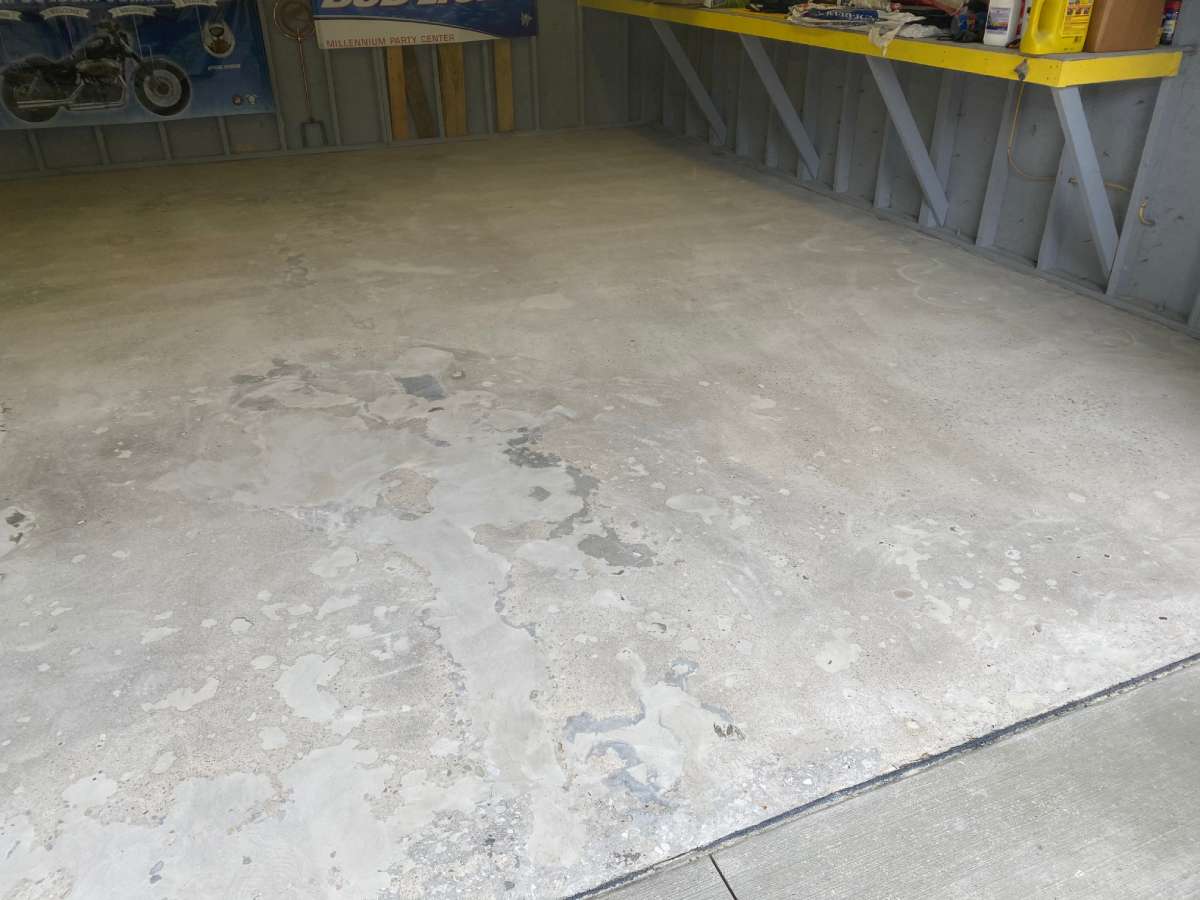
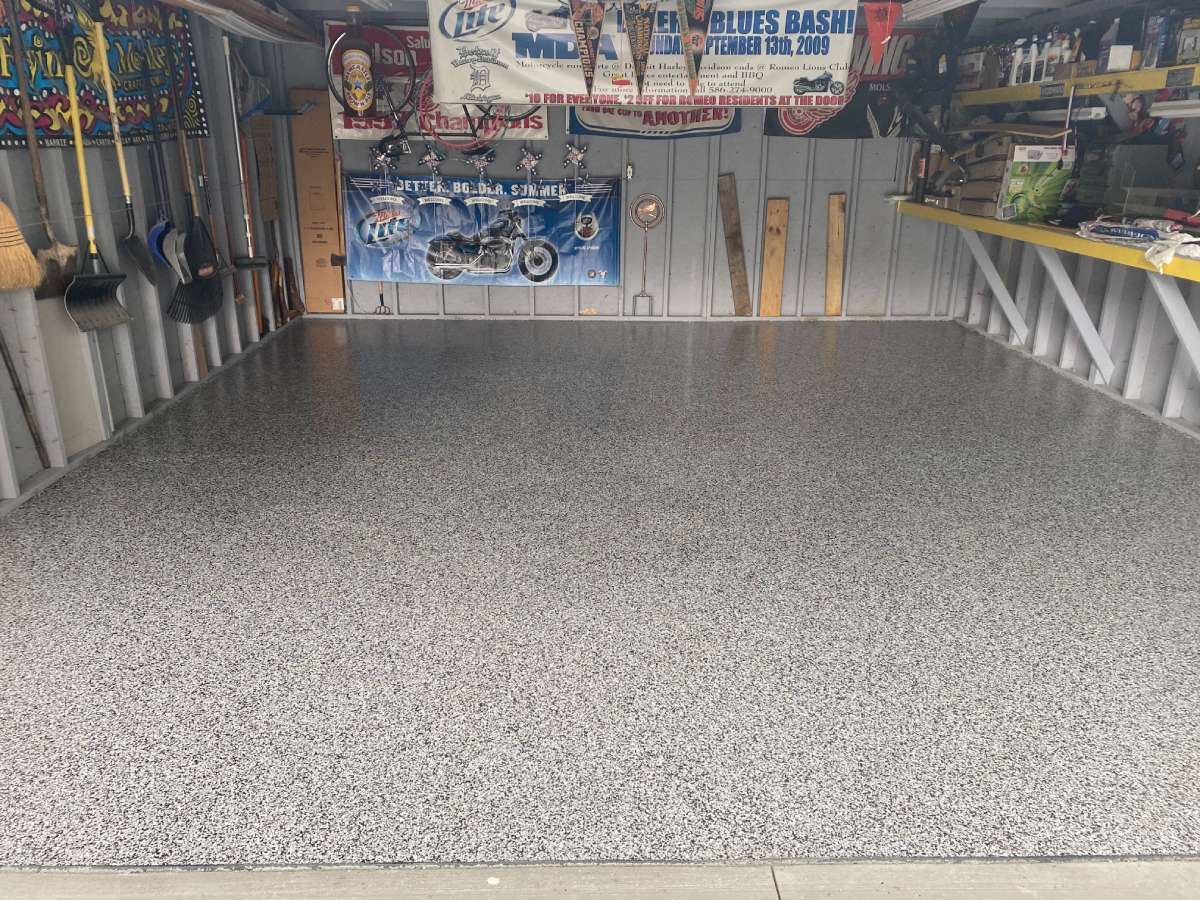
James K Boulevard — 413 Sq Ft, Spalling, Delamination, and a Center Crack
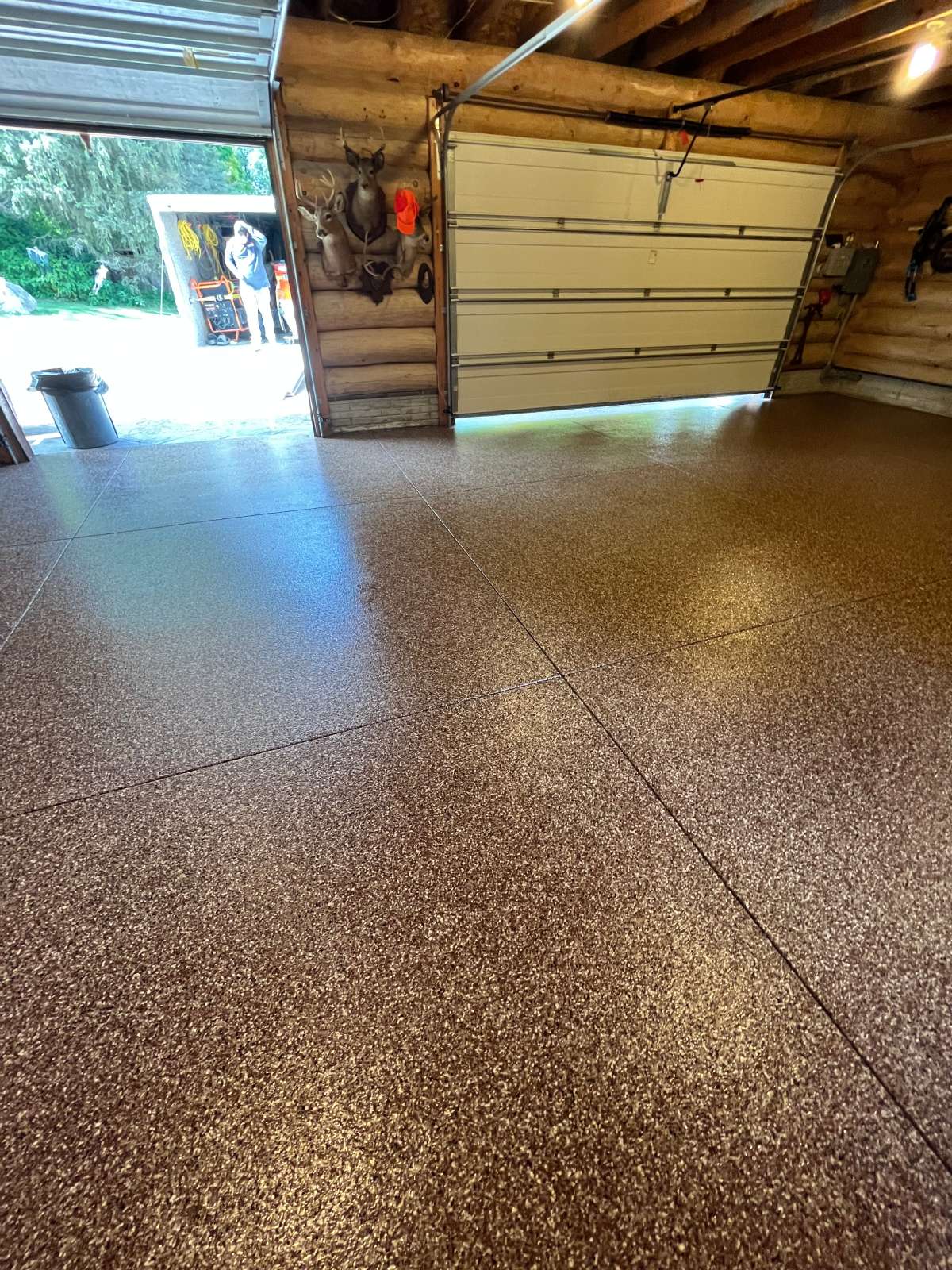
The 413-square-foot slab at James K Boulevard had deteriorated well past normal surface wear: heavy pitting with exposed aggregate across broad areas, spalling and delamination in multiple locations, and a prominent crack running down the center with additional cracking spread throughout. Oil staining and surface contamination covered the rest. A rigid epoxy film has no way to bridge that kind of damage — it needs a slab ground back to sound concrete and rebuilt with flexible repair material underneath it. Our crew diamond-ground the full 413 square feet through every pitted and spalled zone until the slab was fully open, then spread mender compound across each heavily pitted area and pressed more into every crack, troweling everything flush before full cure. The MC-4.5 polyurea base coat went down next, with Domino flake broadcast into the wet surface and a clear polyaspartic topcoat carrying Shark Grip traction additive to finish it.
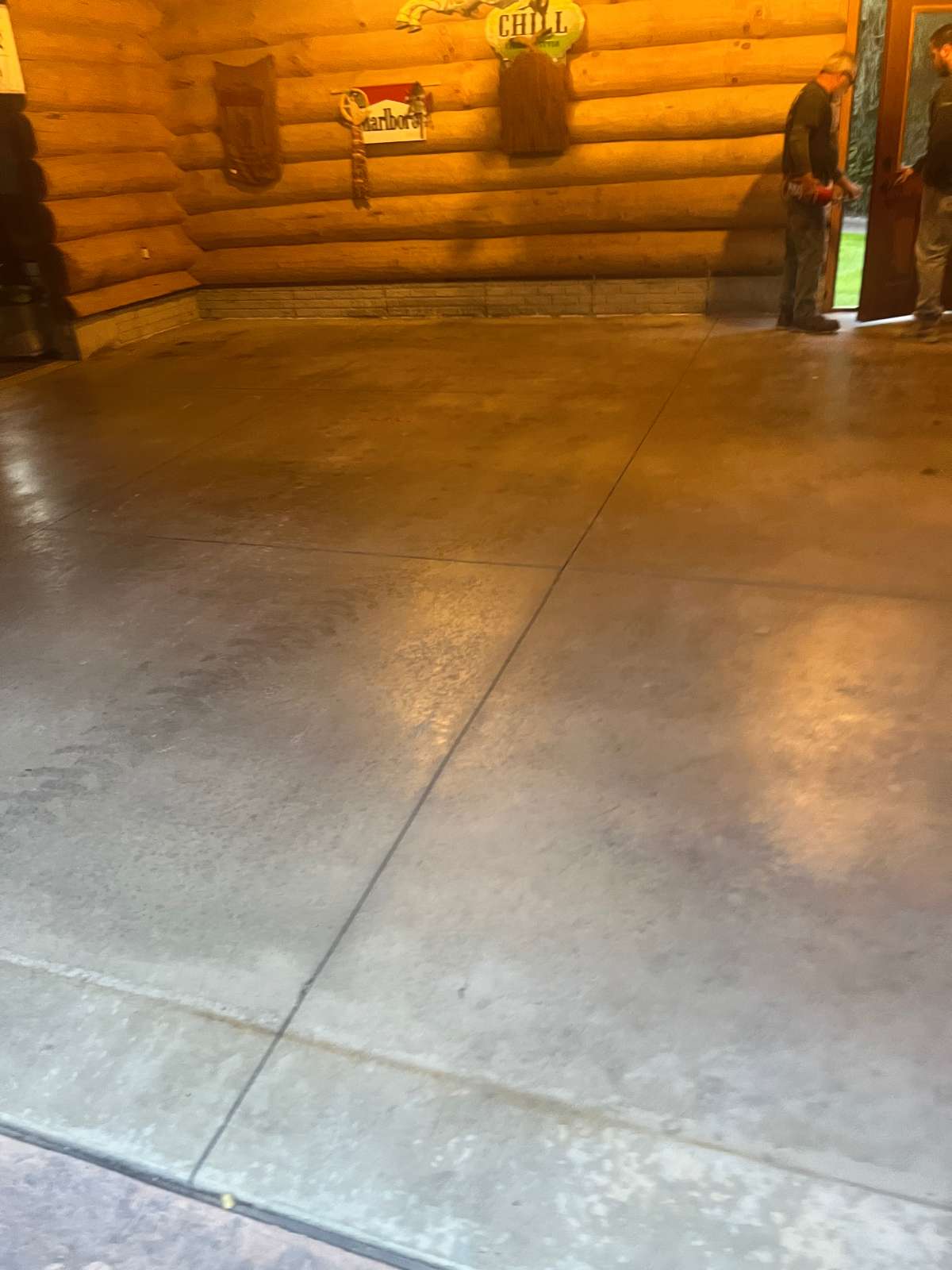
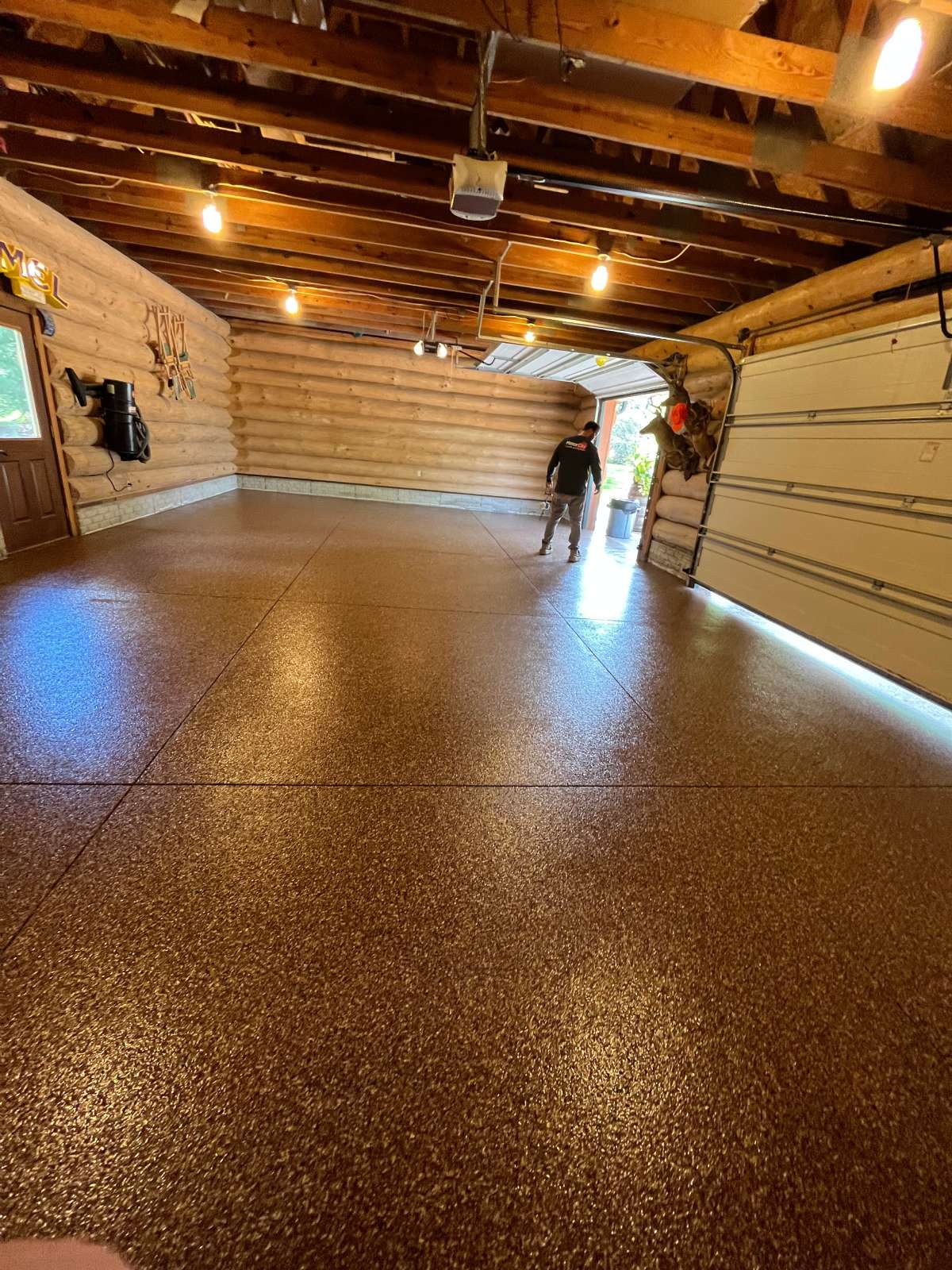
South Lyon — 943 Sq Ft, Oil Staining Across the Largest Slab in Pontiac
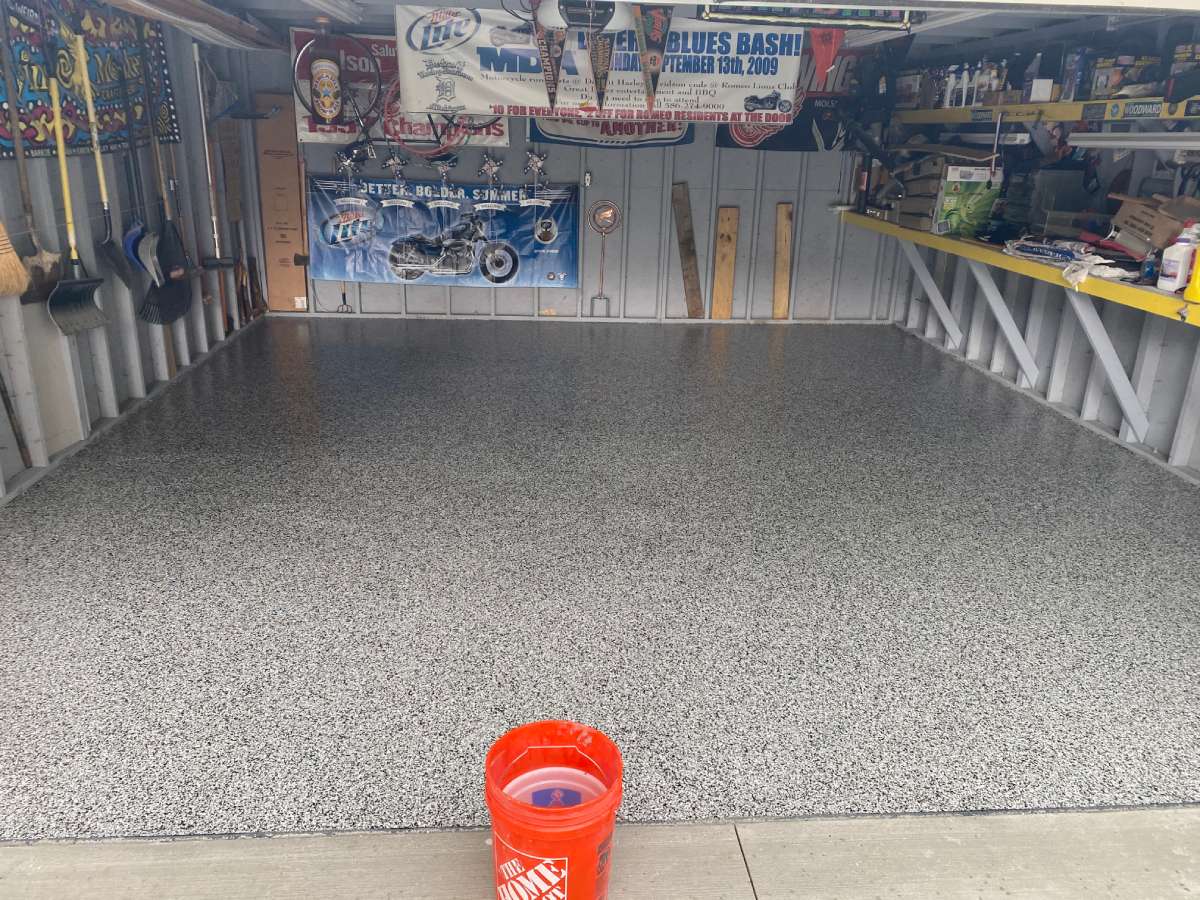
At 943 square feet, the South Lyon slab was the largest in our Pontiac project history — and one of the most contaminated. Oil staining had spread across multiple areas of the floor, with general surface contamination covering the rest and minor pitting scattered throughout. The slab itself was structurally sound; no cracks needed major repair. But contamination like that sits between the concrete and any coating poured over it, and epoxy has no tolerance for what it cannot fully bond to. Our crew diamond-ground the full 943 square feet in multiple passes through every contaminated zone, pulling the laitance layer off the surface and exposing the minor pitting before repair. The MC-4 polyurea base coat went down across the full slab, with Chestnut flake broadcast throughout and a heavy clear topcoat carrying 16-grit traction additive to seal it.
Both jobs point to the same conclusion: a slab does not need a failed coating on it to be a poor fit for epoxy. Deteriorated, cracked concrete and heavily contaminated concrete are each, on their own, conditions a rigid epoxy film handles worse than a diamond-ground, flexible polyurea system.
Epoxy or Polyurea-Polyaspartic, Side by Side
| Epoxy | Polyurea-Polyaspartic | |
|---|---|---|
| Upfront cost, installed | $4.50–$8.50/sq ft ($2,000–$3,500, 2-car garage) | $6–$12/sq ft ($2,800–$5,000, 2-car garage) |
| Cure / return-to-service time | Typically several days, longer in cold weather | As little as 24 hours |
| Flexibility under slab movement | Rigid — can crack or telegraph existing cracks | Flexible — moves with the slab |
| UV stability | Prone to yellowing and ambering with sun exposure | Formulated to resist UV yellowing |
| Moisture tolerance | Vulnerable to bubbling and adhesion loss from vapor | More tolerant, especially with a moisture barrier |
| Resistance to road salt | Can lose adhesion under repeated salt exposure | Built for Michigan freeze-thaw and salt exposure |
| Expected service life (SE Michigan) | 7–15 years professional; 1–3 years DIY kit | 15–20 years |
| Who can install it | Widely available, including DIY kits | Requires a trained crew — no DIY route |
For the chemistry behind these differences, see why polyurea-polyaspartic coatings outperform epoxy.
Cost
A firm price before we have inspected your slab would be misleading. What decides the number is the condition of what is already on the concrete, not just the square footage. Our James K Boulevard job needed serious crack and spalling repair across 413 square feet before any coating could go down. The South Lyon job needed no structural repair, but 943 square feet of heavy oil contamination had to be fully ground away first.
What Moves the Price on a Pontiac Garage
- Spalling and crack repair — our James K Boulevard project needed serious concrete rebuilding before any coating could begin.
- Contamination removal — the South Lyon garage needed 943 square feet of oil staining fully ground away, multiple passes deep.
- Scope, not just size — South Lyon was more than twice the square footage of James K Boulevard, but James K Boulevard’s damage made it the more involved repair.
| Item | Range |
|---|---|
| Professional epoxy, installed | $4.50–$8.50 per sq ft |
| Professional epoxy, typical 2-car garage | $2,000–$3,500 |
| Polyurea/polyaspartic, installed | $6–$12 per sq ft |
| Polyurea/polyaspartic, typical 2-car garage | $2,800–$5,000 |
| Difference between the two on the same garage | roughly $1,000–$1,500 |
| DIY epoxy kit, 2-car garage | $150–$650 |
| Removing a failed coating | $2–$4 per sq ft (roughly $800–$1,800 on a 2-car garage) |
| Service life, professional epoxy (SE Michigan) | 7–15 years |
| Service life, polyurea/polyaspartic (SE Michigan) | 15–20 years |
| Service life, DIY water-based kit | 1–3 years |
A “typical 2-car garage” runs 400–500 square feet, close to James K Boulevard’s 413. Epoxy is cheaper on day one. But at James K Boulevard, that day-one savings would have meant coating over spalling, delamination, and an unrepaired crack. At South Lyon, a rigid film poured over incompletely removed oil contamination is a common recipe for early failure. Day-one savings and lifetime cost are not the same comparison.
Michigan Conditions
Epoxy floor coating in Pontiac has to survive the same freeze-thaw cycling, de-icing salt, and daily vehicle traffic every Oakland County garage sees each winter. Epoxy performs best in a climate-controlled interior industrial floor with no UV, no freeze-thaw, and a substrate free of contamination or damage. An attached, unheated Pontiac garage is a different environment entirely — and it is where the conditions we document, spalling and cracking at James K Boulevard and heavy oil contamination at South Lyon, tend to matter most no matter how carefully the original concrete was placed.
FAQ
A 20×20 garage is 400 square feet, close to the 413-square-foot scope of our James K Boulevard project in Pontiac. Professional epoxy runs $4.50–$8.50 per square foot installed, or roughly $2,000–$3,500 total. At James K Boulevard, that base rate was not the whole bill — heavy pitting, spalling, and a center crack had to be fully repaired before a new system could go down, which adds real cost beyond straightforward square footage.
A typical 2-car garage in the Detroit metro runs 400–500 square feet. Professional epoxy costs $2,000–$3,500 installed; polyurea-polyaspartic runs $2,800–$5,000 — a difference of roughly $1,000–$1,500 on the same garage. Our South Lyon project in Pontiac, at 943 square feet, needed heavy oil contamination ground away across the full slab before coating could begin — a larger scope than a straightforward job of the same size.
Epoxy is a rigid film that depends on sound, clean concrete to perform well — exactly what our James K Boulevard project in Pontiac did not have, with heavy pitting, spalling, delamination, and a prominent crack across the slab. It is also vulnerable to contamination: at South Lyon, oil staining had spread across most of a 943-square-foot floor, exactly the kind of residue that keeps a coating from bonding if it isn’t fully removed. Professional epoxy installations in SE Michigan run 7–15 years; DIY kits typically last only 1–3 years.
For an unheated Detroit-metro garage, a polyurea-polyaspartic system rates highest for durability — 15–20 years in SE Michigan conditions versus 7–15 years for professional epoxy. It also bonds where epoxy struggles: at James K Boulevard in Pontiac, once the spalled, cracked concrete was ground back and repaired, a polyurea-polyaspartic system went down and cured in about 24 hours. The trade-off is cost: polyaspartic runs $6–$12 per square foot installed against $4.50–$8.50 for epoxy, and it requires a trained crew rather than a DIY kit.
See the Full Installations
Both projects are documented in full, with before-and-after photos, on our Pontiac garage floor coating page — see the full story behind James K Boulevard and South Lyon.
Compare Coatings in Nearby Cities
The same comparison, worked through with garages documented in neighbouring cities:
- Coating a garage floor in Auburn Hills: epoxy or polyaspartic?
- Coating a garage floor in Rochester Hills: epoxy or polyaspartic?
For the metro-wide picture — cost ranges, service life, and how each material handles a Michigan winter — see epoxy garage floor coating compared with polyurea-polyaspartic across Metro Detroit.
Get a Quote for Your Pontiac Garage
Every price on this page is a market range, not a quote. What your project costs depends on what’s actually on your slab. Call 248-613-5888 for a free inspection and an accurate number.
MotorCity Floors and Coatings
46101 Grand River Ave, Novi, MI 48374
248-613-5888 · [email protected]