 Skip to content
WHEN a PolyASPARTIC FLOOR COATING WILL DO BETTER THAN an EPOXY FLOOR COATING: TWO INSTALLATIONS in pontiac & South Lyon
QUESTIONS? NEED A QUOTE?
Epoxy OR Polyaspartic Floor COATING?
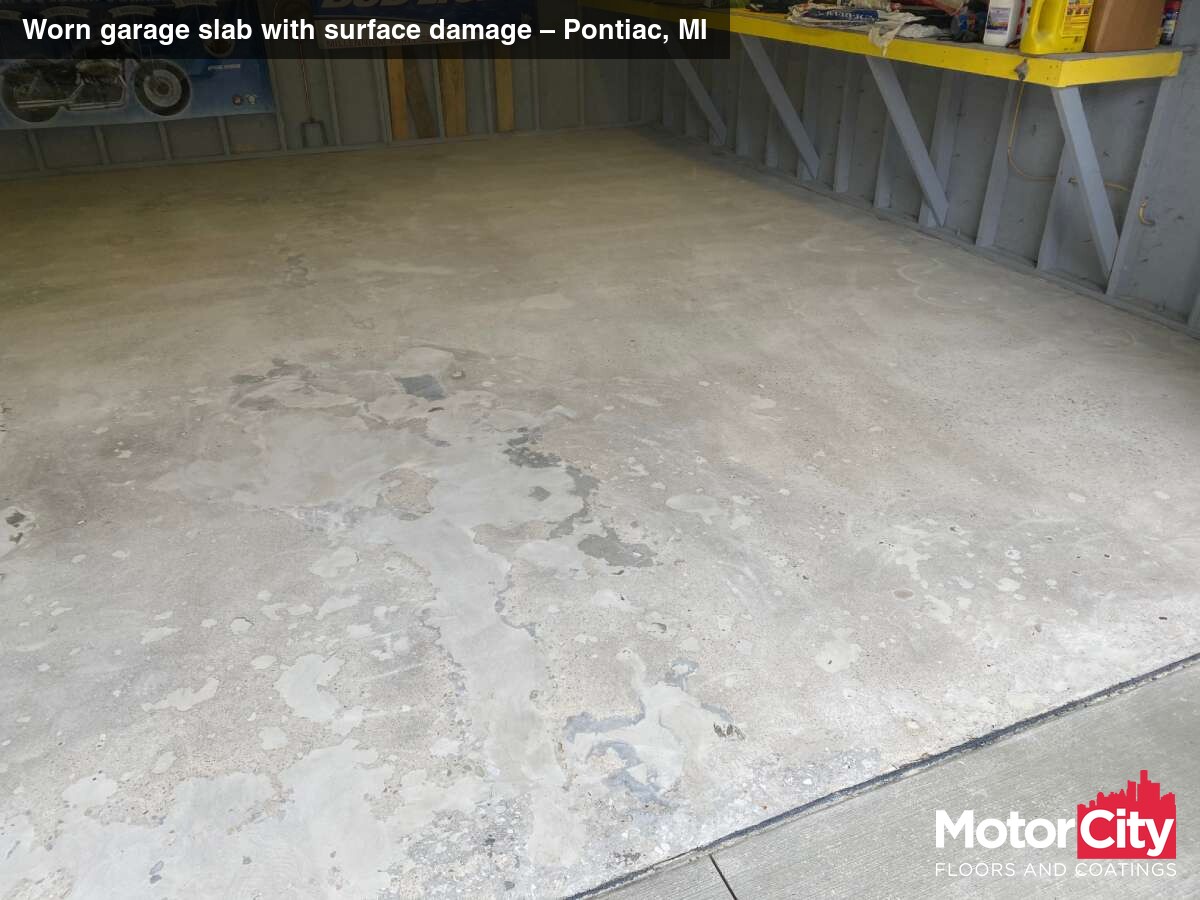
Two garage floors in our project history in Metro Detroit show why epoxy would struggle as a floor coating material. The first project was located on James K Blvd in Pontiac. The 413 sq. ft. slab had deteriorated well past normal wear: heavy pitting with exposed aggregate, spalling and delamination, and a prominent crack running down the center. The second project was located in South Lyon: a 943-square-foot slab that was structurally sound but covered in oil staining and surface contamination across nearly every zone. The details below show that epoxy is not the right floor coating material when the state of the slab guarantees it will fail.
FLOOR COATING PROJECT ON James K BLVD — 413 Sq Ft, Spalling, Delamination, and a Center Crack
The 413 sq.ft. slab at James K Blvd had deteriorated well past normal surface wear: heavy pitting with exposed aggregate across broad areas, spalling and delamination in multiple locations, and a prominent crack running down the center with additional cracking spread throughout. Some oil staining and surface contamination over the rest.
A rigid epoxy film has no way to bridge that kind of damage: the slab needs to be ground back to sound concrete, and rebuilt with flexible repair material underneath.
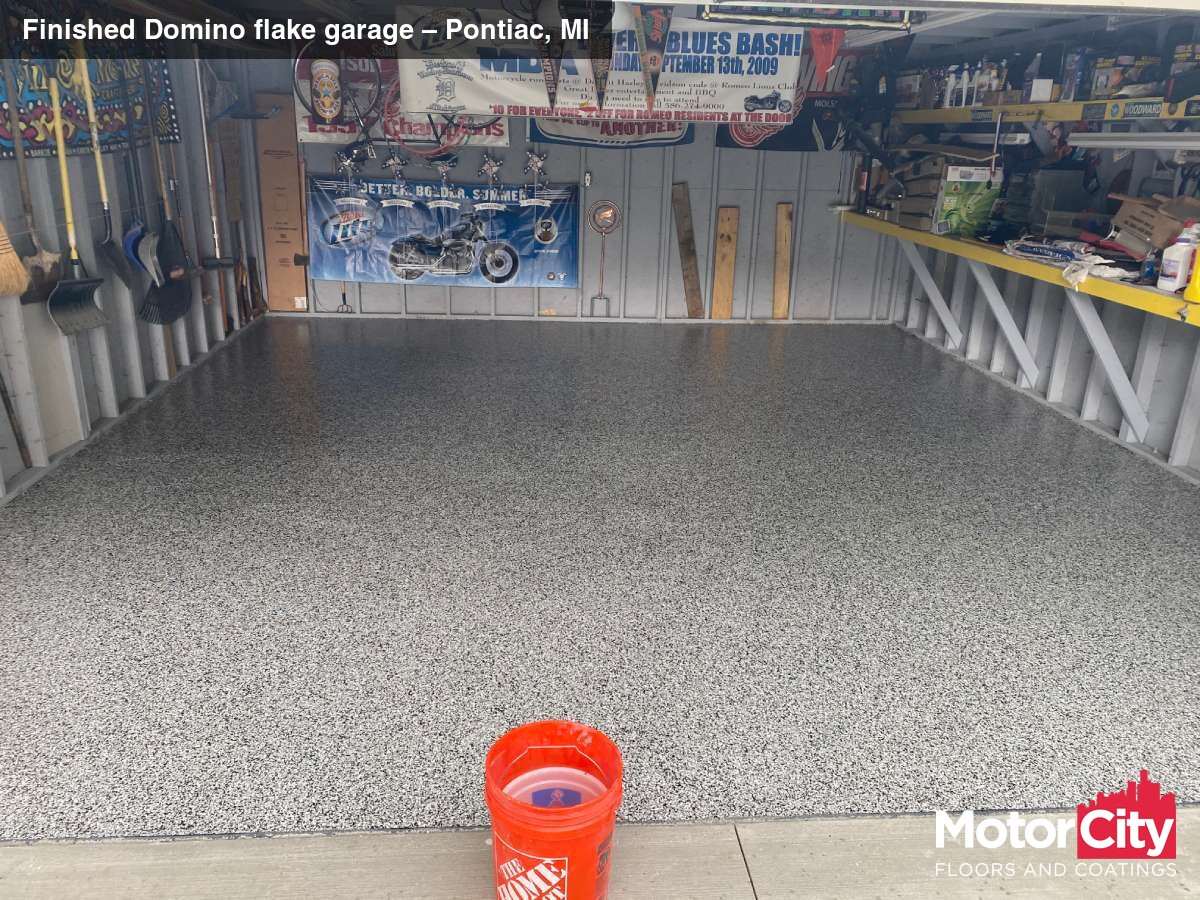
Our crew diamond-ground the full slab through every pitted and spalled zone until the slab was fully open. Then we spread mender compound across each heavily pitted area and pressed more into every crack, troweling everything flush before full cure.
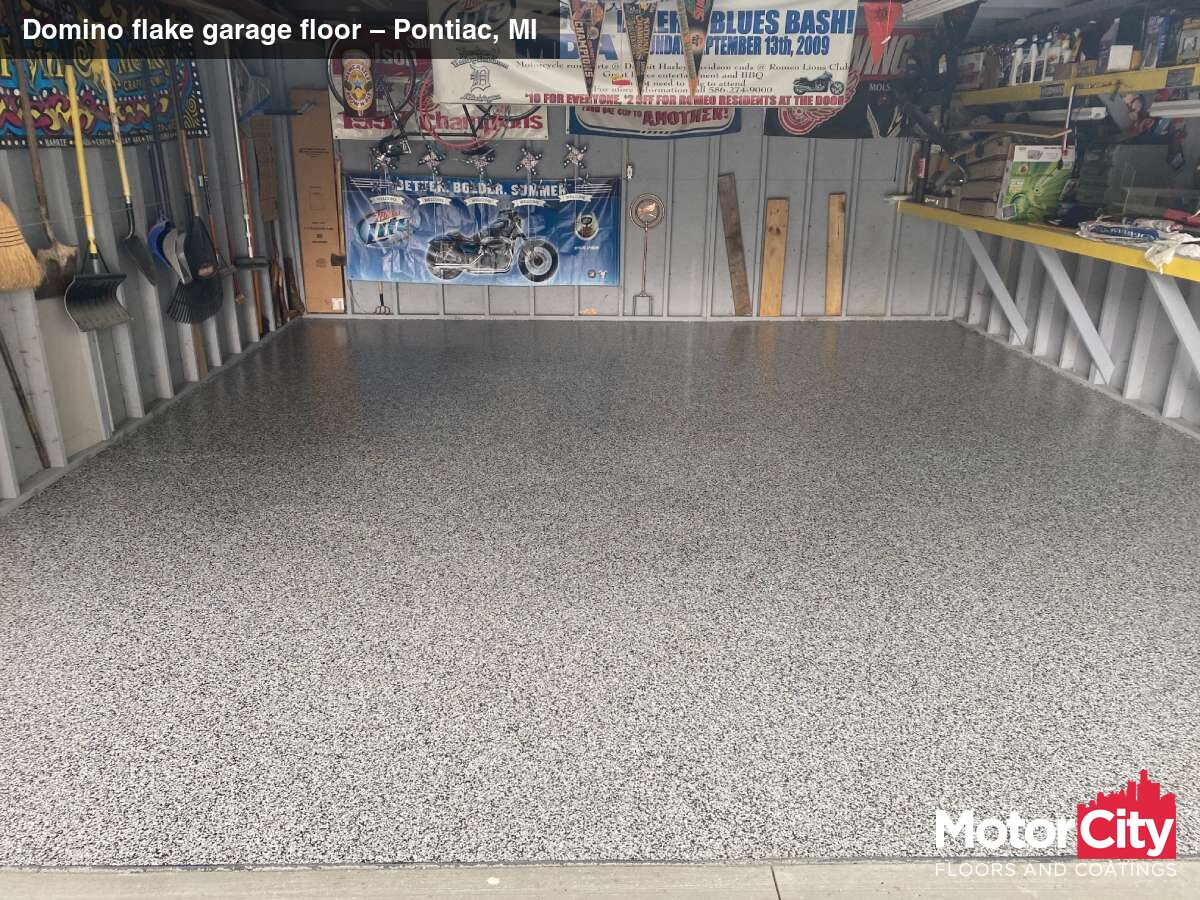
We applied the MC-4.5 polyurea base coat next, and broadcast Domino flakes into the wet surface. Finally, we applied a clear polyaspartic topcoat with Shark Grip traction additive. Perfect finish, perfect adherence to the concrete substrate.
South Lyon FLOOR COATING PROJECT — LARGE SLAB OF 943 Sq Ft, WITH Oil Staining Across
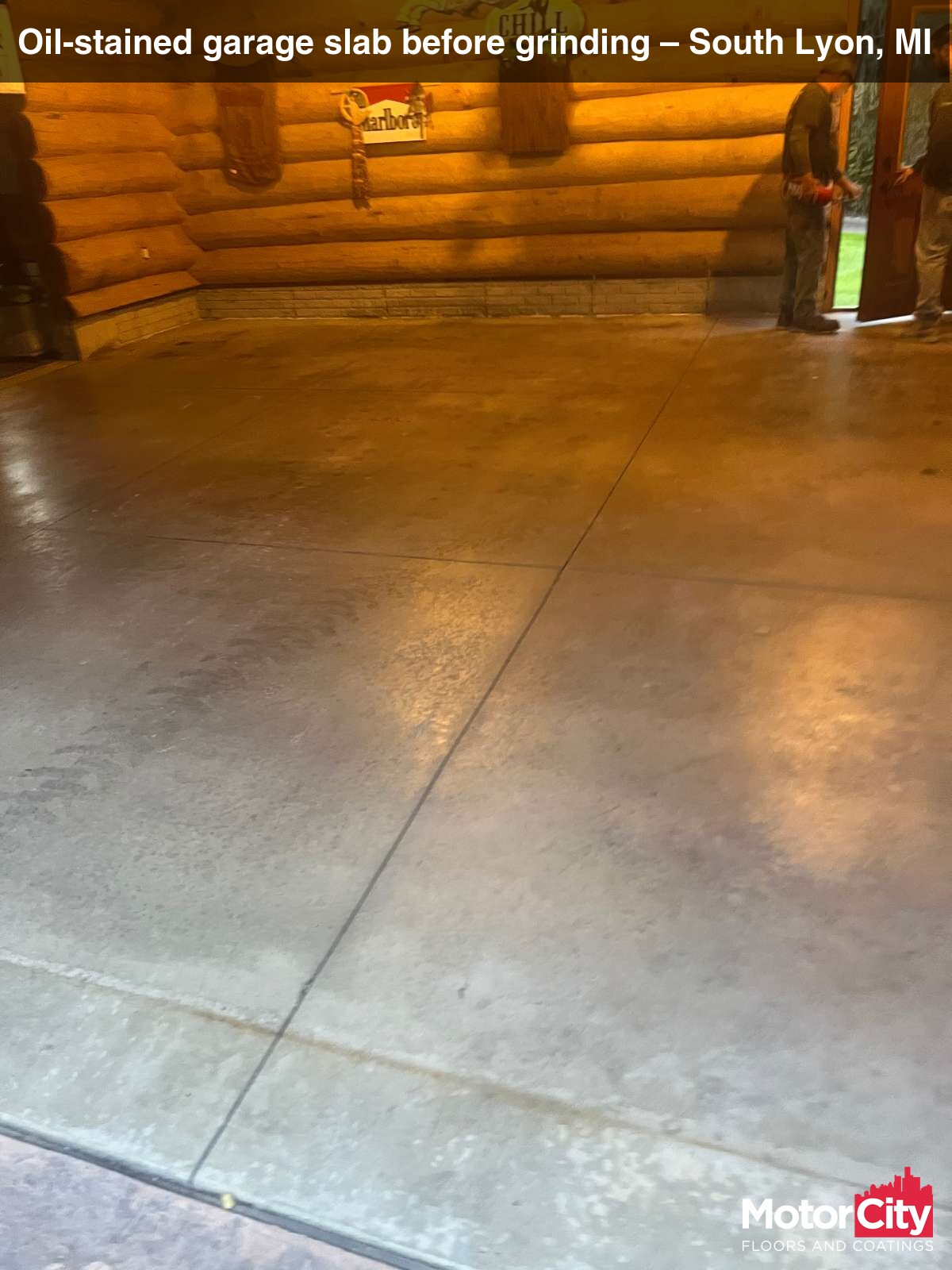
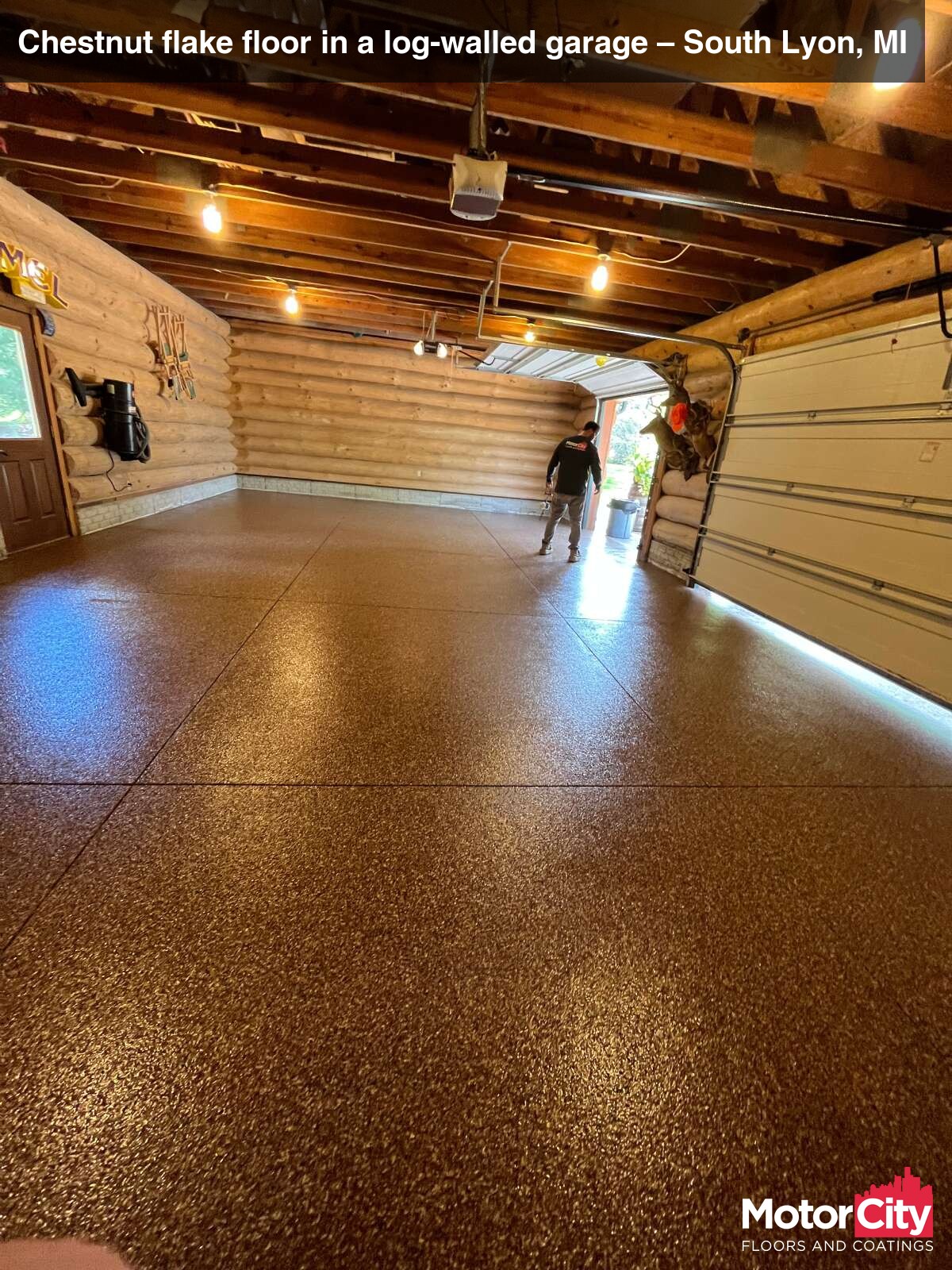
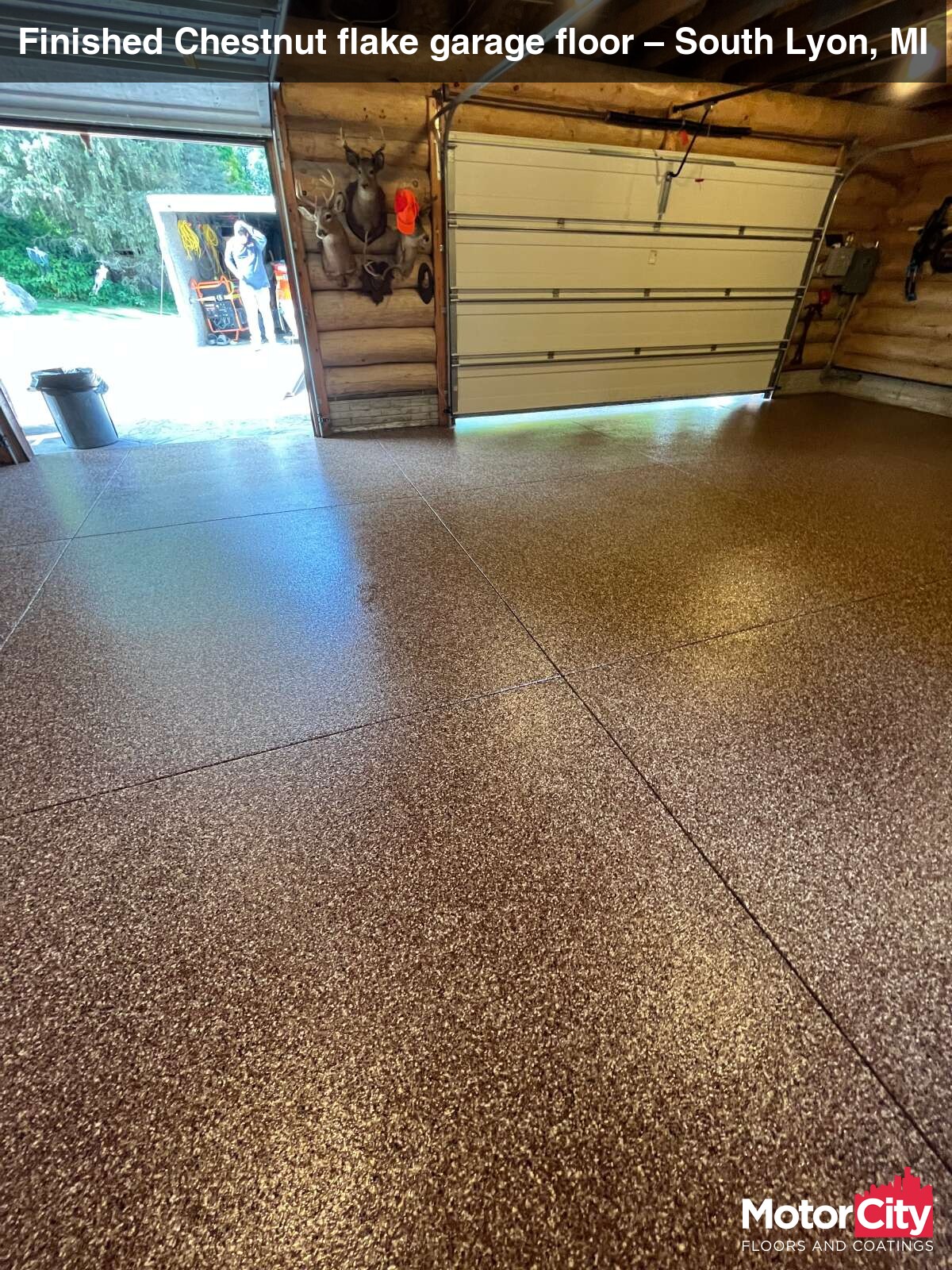
With a surface area of 943 sq.ft., the South Lyon floor coating project slab was the largest we had done in South Lyon. It was also one of the most contaminated concrete slabs we had ever seen. Oil staining had spread across multiple areas of the floor. The rest of the surface showed general contamination and minor pitting scattered throughout. The slab itself was relatively new, and still structurally sound; there was no major crack needing repair.
Heavy contamination like that would sit between the concrete and any floor coating material poured over it. Epoxy has no tolerance for what it cannot fully bond to. Additionally, epoxy is a very rigid material when it is fully cured. A slab of these dimensions is always moving, due to temperature and hygrometric variations: these variations make the concrete expand and contract, which sooner or later creates cracks. The larger the concrete slab, the higher the potential for cracks. Epoxy coating would not be the most appropriate material under the circumstances. On the contrary, the elasticity of polyurea and polyaspartic floor coatings ensures these materials don’t suffer from the natural movements expected from the concrete.
To clean up this big slab, our crew diamond-ground the full 943 sq. ft. in multiple passes, attacking every contaminated zone, pulling the laitance layer off the surface, and exposing all minor pitting. Our crew repaired the surface, then applied the MC-4 polyurea base coat across the full slab. We broadcast a Chestnut flake throughout before the polyurea cured. Then we applied a heavy clear polyaspartic topcoat blended with a 16-grit traction additive to seal the job.
Epoxy or Polyurea-Polyaspartic? Side-by-Side COMPARISON
| Epoxy | Polyurea-Polyaspartic | |
|---|---|---|
| Upfront cost, installed | $4.50–$8.50/sq ft ($2,000–$3,500, 2-car garage) | $6–$12/sq ft ($2,800–$5,000, 2-car garage) |
| Cure / return-to-service time | Typically several days, longer in cold weather | As little as 24 hours |
| Flexibility under slab movement | Rigid — Will crack or telegraph existing cracks | Flexible — moves with the slab |
| UV stability | Prone to yellowing and ambering with sun exposure | Formulated to resist UV yellowing |
| Moisture tolerance | Vulnerable to bubbling and adhesion loss from vapor | More tolerant, especially with a moisture barrier |
| Resistance to road salt | Can lose adhesion under repeated salt exposure | Built for Michigan freeze-thaw and salt exposure |
| Expected service life (SE Michigan) | 7–15 years professional; 1–3 years DIY kit | 15–20 years |
| Who can install it | Widely available, including DIY kits | Requires a trained crew — no DIY route |
For the chemistry behind these differences, see why polyurea-polyaspartic coatings outperform epoxy.
Cost
MotorCity Floors and Coatings can’t give you a firm price before we inspect your slab. What decides the cost is the condition of what is already on the concrete, not just your square footage. The James K Blvd job needed serious crack and spalling repair across 413 sq.ft. before any coating could go down. The South Lyon job needed no structural repair, but we had to grind away 943 sq.ft. of heavy oil contamination.
What Moves the Price of a Garage FLOOR COATING
- Spalling and crack repair — the James K Blvd project needed heavy concrete rebuilding before any coating could begin.
- Contamination removal — the South Lyon garage needed 943 sq.ft. of oil staining decontamination, with deep grinding done in multiple passes.
- Scope, not just size — South Lyon was more than twice the square footage of James K Blvd, but the damage on the latter job made it the more involved repair.
| Cost Comparison Epoxy vs. Polyaspartic Floor Cooating | Range |
|---|---|
| Professional epoxy, installed | $4.50–$8.50 per sq ft |
| Professional epoxy, typical 2-car garage | $2,000–$3,500 |
| Polyurea/polyaspartic, installed | $6–$12 per sq ft |
| Polyurea/polyaspartic, typical 2-car garage | $2,800–$5,000 |
| Difference between the two on the same garage | roughly $1,000–$1,500 |
| DIY epoxy kit, 2-car garage | $150–$650 |
| Removing a failed coating | $2–$4 per sq ft (roughly $800–$1,800 on a 2-car garage) |
| Service life, professional epoxy (SE Michigan) | 7–15 years |
| Service life, polyurea/polyaspartic (SE Michigan) | 15–20 years |
| Service life, DIY water-based kit | 1–3 years |
A “typical 2-car garage” runs 400–500 sq. ft. Epoxy is cheaper as a floor coating material. But on a project like the James K Blvd site, these savings are seriously dented by the preparations required to repair the spalling, delamination, and cracks. At the South Lyon location, a rigid film poured over a very large surface is a common recipe for early failure. Additionally, the preparations required by the surface offset most of the savings on the material. And epoxy will fail faster, which means redoing the job down the road, but that time with an additional step: removing the failed epoxy. That step is also costly.
Michigan WEATHER Conditions
An epoxy floor coating has to survive the same freeze-thaw cycling, de-icing salt, and vehicle traffic every Oakland County garage sees each winter. Epoxy performs best in a climate-controlled interior floor with no UV, no freeze-thaw, and a substrate free of contamination or damage. It is not the longest-lasting floor coating material in our region.
FAQ
A 20×20 garage is 400 square feet, close to the 413-square-foot scope of our James K Boulevard project in Pontiac. Professional epoxy runs $4.50–$8.50 per square foot installed, or roughly $2,000–$3,500 total. At James K Boulevard, that base rate was not the whole bill — heavy pitting, spalling, and a center crack had to be fully repaired before a new system could go down, which adds real cost beyond straightforward square footage.
A typical 2-car garage in the Detroit metro runs 400–500 square feet. Professional epoxy costs $2,000–$3,500 installed; polyurea-polyaspartic runs $2,800–$5,000 — a difference of roughly $1,000–$1,500 on the same garage. Our South Lyon project, at 943 square feet, needed heavy oil contamination ground away across the full slab before coating could begin — a larger scope than a straightforward job of the same size.
Epoxy is a rigid film that depends on sound, clean concrete to perform well — exactly what our James K Boulevard project in Pontiac did not have, with heavy pitting, spalling, delamination, and a prominent crack across the slab. It is also vulnerable to contamination: at South Lyon, oil staining had spread across most of a 943-square-foot floor, exactly the kind of residue that keeps a coating from bonding if it isn’t fully removed. Professional epoxy installations in SE Michigan run 7–15 years; DIY kits typically last only 1–3 years.
For an unheated Detroit-metro garage, a polyurea-polyaspartic system rates highest for durability — 15–20 years in SE Michigan conditions versus 7–15 years for professional epoxy. It also bonds where epoxy struggles: at James K Boulevard in Pontiac, once the spalled, cracked concrete was ground back and repaired, a polyurea-polyaspartic system went down and cured in about 24 hours. The trade-off is cost: polyaspartic runs $6–$12 per square foot installed against $4.50–$8.50 for epoxy, and it requires a trained crew rather than a DIY kit.
See the Full Installations
We documented several projects of the same type, with before-and-after photos, on our Pontiac garage floor coating page — see more case studies there.
Compare Coatings in Nearby Cities
We have published similar garage floor coating comparisons for neighboring cities:
- Coating a garage floor in Auburn Hills: epoxy or polyaspartic?
- Coating a garage floor in Rochester Hills: epoxy or polyaspartic?
To get a clear view of the picture for the Metro Detroit area (cost ranges, service life, and durability of the floor coating material in the Michigan winters), see epoxy garage floor coating compared with polyurea-polyaspartic across Metro Detroit.
Get a Quote for Your Garage Floor Coating in Pontiac and South Lyon
Every price on this page is a market range, not a quote. What your project costs depends on what’s actually on your slab.
Call 248-613-5888 for a free inspection and an accurate number.
MotorCity Floors and Coatings
46101 Grand River Ave, Novi, MI 48374
248-613-5888 · [email protected]