Skip to content
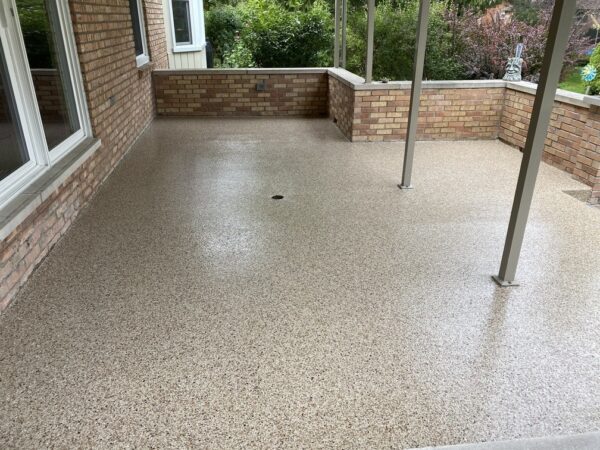
In this article, we will discuss issues with polyurea floor coatings when applied indoor and outdoor. Polyurea is becoming increasingly popular as a coating material in both commercial and residential applications. It offers exceptional durability and chemical resistance. Formed through the reaction of isocyanate components with amine-terminated resins, polyurea creates a very tough but flexible finish. Its properties enable the material to withstand significant wear and tear. Manufactured in various formulations and colors, polyurea coatings are used in residential garages and basements, pool decks and patios, all the way to industrial warehouses, outdoor loading docks and commercial galleys.
However, polyurea isn’t a one-size-fits-all solution. The issues with polyurea floor coatings, observed during and after application, depend to a large degree on whether the coating is applied on an indoor or outdoor surface. Flooring contractors must be fully in command of these environment-specific issues to achieve optimal results for their clients. The same set of issues makes it very difficult for non-professionals to DIY a polyurea floor coating without committing costly mistakes.
Indoor Application Challenges
Let’s start with the indoor issues with polyurea floor coatings as most residential, commercial, and industrial applications happen indoor.
1. Ventilation and VOC Concerns
One of the most significant issues with polyurea floor coatings when applied indoors is volatile organic compound (VOC) emissions generated during the installation process. While polyurea itself has relatively low VOCs compared to solvent-based epoxies, the application process releases fumes that can be straightforward dangerous in enclosed spaces.
The chemical reaction that forms the coating produces strong odors that can linger in the area for 24-48 hours. In a residential applications, homeowners have to vacate their homes during installation. In commercial facilities, operations in the area being coated must be shut down during the application. Oftentimes, the flooring contractor will schedule work during off-hours to avoid disrupting operations.
Solutions: Contractors will make sure the space being coated has adequate cross-ventilation. They position industrial fans to create airflow from one end of the space to another. In facilities that can’t be fully ventilated, it may be necessary to use water-based polyurea alternatives, though these typically sacrifice some performance characteristics. Professional installers always use appropriate respiratory protection, regardless of ventilation.
2. Humidity Control Requirements
In indoor environments, humidity levels typically controlled. This can actually cause issues with polyurea floor coatings when installed indoors. Polyurea cures through a moisture-insensitive reaction, but the substrate preparation and primer coats often require specific humidity ranges—typically between 40-60% relative humidity.
Too much humidity can reduce primer adhesion and create moisture vapor transmission issues from the concrete slab. With too little humidity, common in climate-controlled facilities or during winter months, the coating can cure too quickly in some areas, which yields inconsistent appearance and potential adhesion failures.
Solutions: Polyurea coating installers like MotorCity Floors and Coatings use moisture meters to test concrete slabs before application. When moisture levels exceed 5 pounds per 1,000 square feet over 24 hours (using calcium chloride test), we apply a moisture mitigation primer first. In dry environments, we take care of humidification during the curing period to ensure even cure rates.
3. Substrate Preparation in Confined Spaces
To prepare the substrate properly for polyurea adhesion, flooring contractors use a process involving several stages to create the proper profile: concrete grinding, shot blasting, or acid etching. Indoor spaces present their own set of challenges: dust control, noise restrictions limiting working hours, and equipment maneuverability in tight areas.
Many issues with polyurea floor coatings can be traced back to inadequate surface preparation. Oil stains from vehicles, existing sealers, and laitance (a weak concrete surface layer) must be completely removed. In occupied buildings, the removal process is definitely disruptive. As a result, contractors may cut corners during this phase—never with good results over the long term.
Solutions: We use HEPA-filtered dust collection systems during grinding. For our industrial clients, we schedule work during facility downtime. In noise-sensitive environments, it may be necessary to use scarifying methods rather than shot blasting. And we always verify that the concrete surface profile (CSP) meets the polyurea manufacturer specifications—typically CSP-2 or CSP-3 for these applications.
4. Temperature Consistency During Application
Indoor applications face a paradox: while we have more control over ambient temperature, we also have less ability to adjust it quickly. To avoid issues with polyurea floor coatings, we need to ensure that substrate and ambient temperatures range between 50°F and 90°F during application. You can imagine the sort of challenges we face in large commercial or industrial facilities, maintaining consistent temperatures across an entire floor surface.
Heated slabs in radiant flooring systems and cold spots near exterior doors create temperature zones where the polyurea cures at different rates. This results in color variations and potential adhesion issues down the road. Moreover, polyurea cures quickly—often 30 seconds to a few minutes. There is no time to correct for temperature inconsistencies once application begins.
Solutions: We need to wait enough time for indoor and substrate temperature to stabilize—typically 24 hours before application. We use infrared thermometers to map temperature variations across the floor. In problem areas, we use portable heaters or fans to normalize temperatures. We avoid applying the product when HVAC systems are cycling frequently.
Outdoor Application Challenges
Now that we have covered the issues with polyurea floor coatings during the application process indoors, let’s turn to outdoor applications and their challenges. Most of the time, we deal with patios, stairways and walkways, porches, pool decks, ramps, and driveways. We’ll cover 4 challenges that occur during and after application.
1. UV Degradation and Yellowing
The most significant long-term issue with polyurea floor coatings outdoors is UV degradation. Like with epoxy, standard aromatic polyurea formulations will yellow, chalk, and lose gloss when exposed to sunlight. This doesn’t typically affect the protective properties of the coating immediately, but it impacts appearance and eventually leads to surface breakdown.
Aromatic polyureas are significantly cheaper than aliphatic versions. However, they are essentially unsuitable for outdoor use where aesthetics matter (which is…. everywhere). The yellowing can be quite signiticant—a clear or light-colored coating will turn amber or brown within months of sun exposure.
Solutions: We use aliphatic polyurea formulations for outdoor applications. The material costs 30-50% more than aromatic versions, but it maintains color stability and gloss in UV exposure. For existing aromatic coatings already showing UV damage, it is possible to apply an aliphatic topcoat to restore appearance and provide UV protection. Some contractors add UV inhibitors and stabilizers to their outdoor formulations. The dual-coat system we use includes a polyaspartic topcoat. It does not show any issue with UV exposure.
2. Weather Window Constraints
Outdoor applications face the tyranny of weather forecasting. Polyurea requires stringent conditions during application and initial cure—typically no rain for 24 hours after application, temperatures above 50°F, and substrate temperatures at least 5°F above the dew point to prevent moisture condensation.
The rapid cure time of polyurea becomes a liability when weather changes unexpectedly. Unlike slower-curing epoxies that might tolerate light moisture after a few hours, polyurea in its first hour of cure is particularly vulnerable to moisture contamination. It can cause surface blushing, bubbling, and poor adhesion.
Solutions: We monitor weather forecasts closely and have backup dates scheduled. To heat substrates in cool weather, we use infrared heaters or ground warmers. Applying the coating early in the day ensures we maximize cure time before evening dew points rise. In critical applications, we erect temporary enclosures to protect against unexpected weather. Some contractors use fast-cure polyurea formulations (10-30 second gel times) in iffy weather to reduce exposure time.
3. Thermal Cycling and Expansion
In Michigan, outdoor surfaces are subjected to wide temperature swings—from sub-freezing nights to 100°F+ surface temperatures in direct summer sun. Polyurea is flexible, but the concrete substrate beneath expands and contracts significantly with these thermal cycles.
This movement can cause stress at the coating-substrate interface level, particularly if the concrete has existing cracks (they should be repaired) or control joints. Over time, the coating may de-bond at stress points. Polyurea has the advantage of being flexible; but as it stretches and compresses repeatedly, the material can eventually experience fatigue failure.
Solutions: MotorCity Floors and Coatings ensures all concrete cracks and control joints are properly prepared (cleaned, routed if necessary, and filled with appropriate flexible fillers) before coating. For outdoor applications, we use polyurea formulations with elongation properties exceeding 200%. When we face large control joints, we install expansion joint covers rather than trying to coat it. We apply polyurea when temperatures are moderate (60-75°F) to minimize the locked-in stress from application temperature extremes.
4. Slip Resistance Maintenance
As a coating material, polyurea is by itself smooth and slippery. In outdoor environments, slip resistance is a safety concern. Polyurea can be textured during application using broadcast aggregates or anti-slip additives. But outdoor coatings face unique challenges: organic growth (algae, moss), dirt accumulation, and weathering. All these factors affect surface traction.
Untreated polyurea surfaces become dangerously slippery when wet. We add texture during installation, but outdoor surfaces accumulate contaminants that either increase or decrease slip resistance. This is a bit unpredictable. In shaded areas, algae growth makes surfaces hazardous, even when textured. Homeowners have to receive instructions on how to take care of their polyurea coating to avoid the slip-and-fall issue.
Solutions: MotorCity Floors and Coatings incorporates aluminum oxide, silica sand, or rubber granules into the coating during installation—typically broadcast into the wet coating at 30-50% coverage. For critical areas like ramps or pool decks, we use dedicated anti-slip polyurea formulations. In the course of educating the homeowners on the issues with polyurea floor coatings outdoors, we establish a maintenance schedule that includes pressure washing and application of algaecides in shaded areas. if the customer is concerned with preserving the look of their coating at all times, we may advise them to consider darker colors: they don’t show dirt accumulation as readily and won’t visually highlight organic growth.
Cost Considerations for Both Environments
Whether installing indoors or outdoors, polyurea remains one of the more expensive coating options—typically $3-$8 per square foot installed for basic systems, and $8-$15+ per square foot for high-performance applications. This cost reflects the material expense, specialized equipment requirements (plural-component spray rigs typically cost $15,000-$30,000), and of course, the training and skill level required for proper installation.
Indoor projects may face additional extraneous costs for HVAC modifications and business disruption. Outdoor projects carry costs for weather-related delays, potential re-application if weather interferes, and the more expensive aliphatic formulations.
Note however that the longevity of polyurea—often 15-20 years with proper maintenance, vs. 5-7 years for standard epoxies—justifies the premium. The key is understanding which problems apply to a specific indoor or outdoor application and budgeting accordingly.
Conclusion
You can avoid typical issues with polyurea floor coatings if your contractor understands their environment-specific challenges. Indoor applications demand attention to ventilation, humidity, and surface preparation logistics. Outdoor installations must address UV stability, weather constraints, and thermal cycling.
Because we know how to address these distinct challenge sets and implement the appropriate solutions, we can achieve for our residential and commercial customers a durable, attractive floor coating that performs as intended for years and years on end. To our clients, we say: invest in the higher quality material and a very professional installer. This will always outweigh the cost of premature failure and replacement.
Motorcity Floors and Coatings has been installing polyurea coatings across the Detroit Metro area for years. We have a well-known contractors, and our customers truly appreciate the attention to details we display on every job we do and the quality of the finished surface we obtain for them. They have given us a 4.9 rating in Google Reviews and an A+ rating at the BBB.
If you are considering a polyurea floor coating for your garage, basement, patio, or commercial space, we invite you to see the difference for yourself. Contact MotorCity Floors and Coatings at (248) 613-5888 for a free assessment and quote. Let us show you why a polyurea coating isn’t just any coating—it’s a long-term investment in your property.